|
 |
 |
 |
 |
 |
 |
 |
 |
 |

| . |  |
. |
Cluster And Double Star Pinpoint The Source Of Bright Aurorae
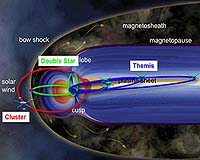
Paris, France (ESA) Sep 12, 2007 Colourful aurorae and perturbations of GPS signals are just some of the effects of a magnetospheric phenomenon known as a magnetic substorm. Up to now, the onset of this phenomenon has been explained by two competing models: current disruption and near-Earth reconnection. A new study published 20 January 2007 in Geophysical Research Letters challenges this binary vision of substorm onset. Thanks to simultaneous measurements performed by the four satellites of the ESA/NASA Cluster mission and the CNSA/ESA Double star mission, a third type of substorm onset is now suggested. Very bright and colourful aurorae due to magnetic substorms are often observed at high latitudes such as Scandinavia or Canada. These aurorae are primarily caused by energetic electrons spiralling down the Earth's magnetic field lines and colliding with atmospheric atoms at altitudes of about 100 km. The energetic electrons come from within the Earth's magnetotail. The magnetotail is a region of space located on the nightside of Earth where the solar wind stretches out terrestrial magnetic field lines into a long tail. In its centre, a denser region known as the plasma sheet is present. A substorm induces violent changes of the characteristics of the plasma sheet. It energizes ions and electrons and hurls them Earthward and substorms can occur as a series or in isolation. Apart from the beautiful light show, substorms also excite a large portion of the Earth's ionosphere, perturbing the reception of GPS signals and communications between Earth and orbiting satellites. Despite decades of space research, the onset mechanism of substorms remains a mystery. What scientists agree on is that three events are associated with the substorm onset: 1) auroral brightening, 2) current disruption, and 3) magnetic reconnection. The auroral brightening is what is visible from the ground: a sudden change of the aurora from light grey to very bright and colourful aurorae at about 100 km altitude. The current disruption occurs at roughly 60 000 km altitude on the nightside, or about 1/6 the distance to the Moon and is associated with large amplitude and turbulent magnetic field fluctuations. Years of data collected in space have shown that magnetic reconnection, which heats and accelerates plasma, occurs on average at around 1/3 the distance to the Moon or 120 000 km, in a thin plane close to the magnetic equator of the magnetotail. So far, space scientists generally believed that these events occur in one of the two following sequences However, a recent study published 20 January 2007 in Geophysical Research Letters, challenges this vision of substorm onset, thanks to a fortuitous spacecraft constellation of the four satellites composing the ESA/NASA Cluster mission and the two satellites of the CNSA/ESA Double Star mission. Data collected on 26 September 2005 between 08 and 10 UT captured the occurrence of three consecutive substorm onsets. But for the first time, these data indicate that the current disruption process and magnetic reconnection can coincide in space and time showing possibly the two sides of the same process. Professor Sergeev (St Petersburg State University, Russia) and co-authors also found that in this case, magnetic reconnection occurred closer to the Earth than usual, almost co-located with the current disruption process, between 60 000 km and 90 000 km. Related localized auroral brightenings were captured a few tens of seconds later by an ultra violet (UV) imager onboard the NASA IMAGE satellite. Mid-February 2007, NASA launched a mission called THEMIS, dedicated to the study of substorm onset. It is composed of five spacecraft. The on-going satellite measurements are associated with a network of all-sky cameras and magnetometers on the ground in Canada and northern United States to monitor the auroral activity. The five satellites are in the process of being placed in a special orbit so that every four days, they will line up in the magnetotail to simultaneously monitor the current disruption region and the magnetic reconnection region. "Thanks to Cluster, Double Star and the THEMIS missions, this is the first time in history of space physics that such a high number of scientific satellites are in operation simultaneously. It represents an unprecedented opportunity to study the global solar-magnetospheric environment and the physical processes involved. And one of the prime scientific targets is a better understanding of substorm onset," says Philippe Escoubet, Cluster and Double Star project scientist of the European Space Agency. Community Email This Article Comment On This Article Related Links Double Star Mission THEMIS at NASA The Physics of Time and Space
 ESA's Earth Explorer Gravity Satellite On Show
 Paris, France (SPX) Jul 20, 2007
GOCE, ESA's first satellite dedicated to measuring the Earth's gravity field, has been presented to the press today in Turin, Italy, before being shipped to ESTEC - the space agency's research and technology centre in the Netherlands - for final testing. The Gravity field and steady-state Ocean Circulation Explorer(GOCE), the first core Earth Explorer mission to be developed as part of ESA's Living Planet Programme, will significantly advance our knowledge of how the Earth works and provide insight into ocean circulation, sea-level change, climate change, volcanism and earthquakes. |
|
|

| The content herein, unless otherwise known to be public domain, are Copyright 1995-2006 - SpaceDaily.AFP and UPI Wire Stories are copyright Agence France-Presse and United Press International. ESA PortalReports are copyright European Space Agency. All NASA sourced material is public domain. Additionalcopyrights may apply in whole or part to other bona fide parties. Advertising does not imply endorsement,agreement or approval of any opinions, statements or information provided by SpaceDaily on any Web page published or hosted by SpaceDaily. Privacy Statement |