
 |
 |
 |
 |
 |
 |
 |
 |
 |
 |

| . |  |
. |
Cluster Detects Invisible Escaping Ions
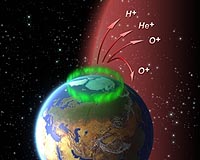
Paris, France (ESA) Jan 15, 2009 For the first time, it has been possible to quantify the amount of hydrogen naturally escaping each year from the Earth's atmosphere. This hydrogen outflow has been shown to be of the order of thousands of tons. The result was obtained by applying a new analytical method to a unique set of electric field data collected by the European Space Agency's Cluster mission. The escaping hydrogen has previously been invisible to classical particle detectors on satellites due to its very low energy. Quantifying the loss processes of our atmosphere is important not only for providing a better understanding of the physical phenomena in near-Earth space, but also for understanding the evolution of atmospheres on other planets, such as Venus or Mars. Prior to the space age, scientists believed that the magnetic environment of the Earth was mainly filled with particles of solar origin, forming an immense comet-like cloud of electrified gas surrounding our planet. Later, observations made by scientific satellites revealed that hydrogen, oxygen and helium ions can escape from the Earth's upper atmosphere into space from regions near the Earth's poles (Figure 1). These escaping ions will be lost to the solar wind or trapped in the plasma sheet - the central region of the magnetic tail. There, they can undergo acceleration processes and, in a kind of boomerang effect, return back to Earth with higher energy, thus posing a hazard to satellites and astronauts. Last year, a report based on Cluster data revealed the dominant mechanism driving the escape (see Cluster examines Earth-escaping ions). However, to date, an accurate estimation of the annual amount of matter leaking out into space has remained elusive. The reason is actually simple. Most of these ions are too cold to be observed by scientific satellites, since the potential of a sunlit spacecraft exceeds the equivalent energy of these ions (~ 1 eV). The low-energy ions are thus repelled by the spacecraft and cannot even reach the onboard particle detectors. PhD student Erik Engwall from Uppsala University and the Swedish Institute of Space Physics (Uppsala, Sweden) challenged this question using electric field data sets measured by two instruments, which use different techniques, on the Cluster satellites. When operated in a cold, flowing plasma, these two instruments show large differences, since one of them is greatly affected by the presence of such an environment. While first seen as a disturbance or interference of the measurements, Engwall and colleagues have developed a new method taking advantage of these differences to reveal the presence of cold ions (mostly hydrogen at high altitudes) and to determine their flow velocity. The outcome of this new data analysis method applied to Cluster data (see Figure 2) is detailed in the January 2009 edition of Nature Geoscience . "Not only does our new method show the presence of cold ions in the distant tail lobes, but our quantitative estimation shows that these cold ions dominate in both flux and density. The so far invisible cold plasma outflows constitute a major part of the net loss of matter from the Earth", concludes Engwall, the lead author of this study. "This scientific discovery shows once again a clear advantage of measuring key physical parameters on the same satellite using different experimental means", says Philippe Escoubet, Cluster project scientist at the European Space Agency. Reference publication: Engwall, E., et al., (2009), Earth's ionospheric outflow dominated by hidden cold plasma, Nature Geoscience, January 2009. DOI:10.1038/ngeo387 Share This Article With Planet Earth
Related Links Cluster Solar Science News at SpaceDaily
 IBEX Building First All-Sky Map Of The Edge Of The Solar System
 San Antonio TX (SPX) Jan 14, 2009
Following two months of commissioning, during which the spacecraft and sensors were tuned for optimum mission performance, the Interstellar Boundary Explorer (IBEX) spacecraft began gathering data to build the first maps of the edge of the heliosphere, the region of space influenced by the Sun. |
|
|

| The content herein, unless otherwise known to be public domain, are Copyright 1995-2007 - SpaceDaily.AFP and UPI Wire Stories are copyright Agence France-Presse and United Press International. ESA Portal Reports are copyright European Space Agency. All NASA sourced material is public domain. Additional copyrights may apply in whole or part to other bona fide parties. Advertising does not imply endorsement,agreement or approval of any opinions, statements or information provided by SpaceDaily on any Web page published or hosted by SpaceDaily. Privacy Statement |
 del.icio.us
 Digg
Digg Reddit
 YahooMyWeb
 Google
 Facebook