
 |
 |
 |
 |
 |
 |
 |
 |
 |
 |

| . |  |
. |

Boston MA (SPX) Apr 15, 2011 A new analysis of one of the most well-known meteorites on Earth provides strong evidence that the prevailing view of many asteroids is wrong. Rather than randomly mixed blobs of rock and dust stuck together, it appears that the asteroid that was the source of the Allende meteorite was large enough to have had a molten core, even though its surface remained cold and solid. The new view also suggests that astronomers' view of how planets like the Earth formed may need revision. The Allende meteorite fell in Mexico in 1969, shattering into thousands of fragments as it slammed into the Earth's atmosphere and strewing them across dozens of miles of desert. More than two tons of scattered pieces have been found, and it has become perhaps the best-studied meteorite ever. When the solar system formed, planets built up through the slow accumulation of smaller objects that collided and stuck together. When these growing collections of rubble reached a certain size, radioactive elements within them heated up enough so that the rock melted, and heavier elements tended to sink toward their cores. This separating process (known as differentiation) ended up producing concentric layers of different composition, structured like the layers of an onion. In the metallic cores at the centers of these bodies, swirling eddies of molten metal would produce a magnetic field. Planetary scientists have long thought that asteroids that formed cores must have completely differentiated and melted throughout their interiors. Now, new findings by planetary scientists at MIT and other institutions suggest that may not be the case: that many asteroids with cores might be only partially differentiated, with their outer regions largely unmelted. "It's a new paradigm for how people imagine the parent bodies of meteorites," says Benjamin Weiss, associate professor of planetary sciences and paleomagnetism in MIT's Department of Earth, Atmospheric and Planetary Sciences (EAPS). The shift in thinking comes from a combination of laboratory work and theoretical modeling. The lab studies, led by former MIT postdoctoral scholar Laurent Carporzen, found evidence for magnetization, apparently built up over a period of millions of years, in a piece of the Allende meteorite. A separate theoretical analysis, led by Linda Elkins-Tanton, the Mitsui Career Development Associate Professor of Geology in EAPS, showed exactly how such magnetization could have occurred - and why that changes not just our view of asteroids, but also of how all the planets formed and where the water that fills Earth's oceans came from. The two lines of evidence were published this month in a two related papers, one appearing in the journal Proceedings of the National Academy of Sciences, the other in Earth and Planetary Science Letters. Weiss is a co-author of both papers. The Allende meteorite is a type called a carbonaceous chondrite. Chondrites are conglomerates of tiny pieces (called chondrules and inclusions) stuck together, and the individual pieces are thought to be remnants of the primordial cloud of material that originally collapsed to form the solar system. "Many of these are the oldest solar system solids we know of," Weiss says. The new analysis shows that while newly formed asteroids melted from the inside out because of their radioactive elements, their surfaces, exposed to the cold of space and continuing to accumulate layers of new, cold fragments, remained cold. Computer modeling of the cooling process by Elkins-Tanton clearly shows this disparity of a molten interior and cold, unmelted crust, she says. The decisive new evidence came from studies of the way mineral grains within the meteorite are magnetized: the magnetic orientations of all the grains line up, showing that they became magnetized after the material had all become stuck together, rather than being a remnant of earlier magnetic fields in the swirling cloud of dust from which the object formed. In addition, using a form of radiometric dating involving isotopes of xenon, they could determine that the magnetization took place over a period of millions of years. That rules out an alternative theory that the grains could have become magnetized as a result of a brief pulse of magnetism in the cloud of dust itself. The finding has implications far beyond the specific asteroid that was the source of this meteorite: "It says there's a whole spectrum of planetary bodies, from fully melted to unmelted," Weiss says. Erik Asphaug, professor of earth and planetary sciences at the University of California at Santa Cruz and a specialist in asteroids and comets, finds the case compelling. "The magnetic data is difficult to argue with - that the Allende meteorite acquired magnetization late, and apparently from a stable field. I am convinced about that," he says. Weiss and Elkins-Tanton, he says, "have made a firm association, for the first time, between differentiated parent bodies and chondrule-rich objects." Asphaug adds "I think their conclusion has very significant implications, in that many differentiated asteroids can be 'dressed' in chondrule clothing." The new research also provides important information about the whole process of planet formation and how long it took, says Elkins-Tanton. The analysis shows that the parent body must have formed within just 1.5 million years, she says. "The question is, what fraction of planetesimals formed in that period of time? It turns out to be a lot." Her calculations show that the planetesimals that stuck together to form the early Earth, even though the heating process would have made them drier than previously thought, would still have retained enough water within their unmelted outer regions to produce the oceans. That contradicts a widely held view of planet formation in which the vast majority of the water and other volatile materials on Earth arrived later, delivered by impacting comets and asteroids. It also implies that this process must have been commonplace in planet formation, and greatly improves the odds that most of the planets around other stars will also have abundant water, she says, which is considered an essential prerequisite for life as we know it. As we study distant planets around other stars, "This increases the probability of finding life in a form that we would recognize it," she says.
Share This Article With Planet Earth
Related Links MIT Asteroid and Comet Mission News, Science and Technology

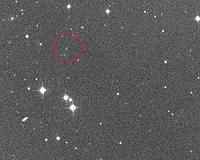 WISE Mission Spots 'Horseshoe' Asteroid
Pasadena CA (JPL) Apr 12, 2011 An asteroid recently discovered by NASA's Wide-field Infrared Survey Explorer (WISE) may be a bit of an oddball. Most near-Earth asteroids - NEAs for short - have eccentric, or egg-shaped, orbits that take the asteroids right through the inner solar system. The new object, designated 2010 SO16, is different. Its orbit is almost circular such that it cannot come close to any other planet in the s ... read more |
|
|
| The content herein, unless otherwise known to be public domain, are Copyright 1995-2010 - SpaceDaily. AFP and UPI Wire Stories are copyright Agence France-Presse and United Press International. ESA Portal Reports are copyright European Space Agency. All NASA sourced material is public domain. Additional copyrights may apply in whole or part to other bona fide parties. Advertising does not imply endorsement,agreement or approval of any opinions, statements or information provided by SpaceDaily on any Web page published or hosted by SpaceDaily. Privacy Statement |


 del.icio.us
 Digg
Digg Reddit
 YahooMyWeb
 Google
 Facebook


