|
 |
 |
 |
 |
 |
 |
 |

| . |  |
. |

|
|
. |

 by Staff Writers Paris (AFP) June 8, 2011
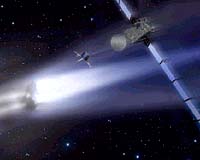
A billion-euro (1.47-billion-dollar) space probe was placed in hibernation on Wednesday until 2014, when it will be woken for a deep-space rendezvous with a comet, the European Space Agency (ESA) said. The unmanned scoutcraft, Rosetta, is on a 10-year mission in which it will cover 7.1 billion kilometers (4.4 billion miles). In May 2014, it is due to meet up with Comet 67/P Churyumov-Gerasimenko 675 million kilometres (422 million miles) from home and then send down a refrigerator-sized lab called Philae to probe its surface. At 1258 GMT Wednesday, ESA's Space Operations Centre in Darmstadt, Germany, sent a final command to close down almost all the onboard systems, including radio contact with Earth, thus sending Rosetta into a long sleep. The three-tonne craft's solar panels will provide power for an onboard timer, which will count down the seconds to a wakeup call at exactly 1000 GMT on January 20 2014, ESA said in a press release. The solar wings will also provide the electricity for several heaters to ensure the spacecraft does not freeze up. "We sent the command via NASA's 70-metre (227-feet) Deep Space Network station in Canberra, Australia, ensuring the signal was transmitted with enough power to reach Rosetta," Spacecraft Operations Manager Andrea Accomazzo said. "We'll monitor via ESA's 35m (114-feet) station at New Norcia in Australia for a few days to see if any problems occur, but we expect to receive no radio signal until 2014. Rosetta's on her own now." Rosetta's mission manager, Gerhard Schwehm, admitted to a frisson as the spacecraft -- approved as a project in 1993 and launched in 2004 -- was put into sleep mode. "We were all sitting there, watching. It was a special moment," he told AFP by phone. Comets are a passionate subject of interest for solar scientists. The theory is that they are "dirty snowballs" of ice and primordial dust that can provide insights into the building of the Solar System. Hibernation is the loneliest part of Rosetta's trip, a mission that is one of the biggest gambles in the history of space exploration. To get to its distant meeting point, Rosetta had to play planetary billiards for five years, using four "gravitational assists" from Earth and Mars as slingshots to build up speed. The craft also flew close by two asteroids, providing it with an excellent opportunity to calibrate its instruments. Rosetta has already set a distance record for a spacecraft that is powered by solar energy alone. Deep-space probes usually have an atomic source to supplement their power when sunlight is very weak. Schwehm said that the spacecraft's systems were in excellent health, although use of fuel to make course corrections had been slightly less efficient than hoped. But this should not affect the mission's goals or timetable in any way, he said. After tracking the comet, Rosetta will escort it during its loop around the Sun, with the mission scheduled to end in December 2015.
|
. |
|
| The content herein, unless otherwise known to be public domain, are Copyright 1995-2011 - Space Media Network. AFP and UPI Wire Stories are copyright Agence France-Presse and United Press International. ESA Portal Reports are copyright European Space Agency. All NASA sourced material is public domain. Additional copyrights may apply in whole or part to other bona fide parties. Advertising does not imply endorsement,agreement or approval of any opinions, statements or information provided by Space Media Network on any Web page published or hosted by Space Media Network. Privacy Statement |

 del.icio.us
 Digg
Digg Reddit
 Google