
 |
 |
 |
 |
 |
 |
 |
 |
 |
 |

| . |  |
. |

Science@NASA Pasadena CA (JPL) Nov 19, 2010 NASA has just issued a travel advisory for spacecraft: Watch out for Comet Hartley 2, it is experiencing a significant winter snowstorm. Deep Impact photographed the unexpected tempest when it flew past the comet's nucleus on Nov. 4th at a distance of only 700 km (435 miles). At first, researchers only noticed the comet's hyperactive jets. The icy nucleus is studded with them, flamboyantly spewing carbon dioxide from dozens of sites. A closer look revealed an even greater marvel, however. The space around the comet's core is glistening with chunks of ice and snow, some of them possibly as large as a basketball. "We've never seen anything like this before," says University of Maryland professor Mike A'Hearn, principal investigator of Deep Impact's EPOXI mission. "It really took us by surprise." Before the flyby of Hartley 2, international spacecraft visited four other comet cores-Halley, Borrelly, Wild 2, and Tempel 1. None was surrounded by "comet snow." Tempel 1 is particularly telling because Deep Impact itself performed the flyby. The very same high resolution, high dynamic range cameras that recorded snow-chunks swirling around Hartley 2 did not detect anything similar around Tempel 1. "This is a genuinely new phenomenon," says science team member Jessica Sunshine of the University of Maryland. "Comet Hartley 2 is not like the other comets we've visited." The 'snowstorm' occupies a roughly-spherical volume centered on Hartley 2's spinning nucleus. The dumbbell-shaped nucleus, measuring only 2 km from end to end, is tiny compared to the surrounding swarm. "The ice cloud is a few tens of kilometers wide--and possibly much larger than that," says A'Hearn. "We still don't know for sure how big it is." Data collected by Deep Impact's onboard infrared spectrometer show without a doubt that the particles are made of frozen H2O, i.e., ice. Chunks consist of micron-sized ice grains loosely stuck together in clumps a few centimeters to a few tens of centimeters wide. "If you held one in your hand you could easily crush it," says Sunshine. "These comet snowballs are very fragile, similar in density and fluffiness to high-mountain snow on Earth." Even a fluffy snowball can cause problems, however, if it hits you at 12 km/s (27,000 mph). That's how fast the Deep Impact probe was screaming past the comet's nucleus. An impact with one of Hartley 2's icy chunks could have damaged the spacecraft and sent it tumbling, unable to point antennas toward Earth to transmit data or ask for help. Mission controllers might never have known what went wrong. "Fortunately, we were out of harm's way," notes A'Hearn. "The snow cloud does not appear to extend out to our encounter distance of 700 km. Sunlight sublimates the icy chunks before they can get that far away from the nucleus." The source of the comet-snow may be the very same garish jets that first caught everyone's eye. The process begins with dry ice in the comet's crust. Dry ice is solid CO2, one of Hartley 2's more abundant substances. When heat from the sun reaches a pocket of dry ice-poof!-it instantly transforms from solid to vapor, forming a jet wherever local topography happens to collimate the outrushing gas. Apparently, these CO2 jets are carrying chunks of snowy water ice along for the ride. Because the snow is driven by jets, "it's snowing up, not down," notes science team member Peter Schultz of Brown University. Ironically, flying by Hartley 2 might be more dangerous than actually landing on it. The icy chunks are moving away from the comet's surface at only a few m/s (5 to 10 mph). A probe that matched velocity with the comet's nucleus in preparation for landing wouldn't find the drifting snowballs very dangerous at all--but a high-speed flyby is another matter. This is something planners of future missions to active comets like Hartley 2 will surely take into account. Comet snowstorms could be just the first of many discoveries to come. A'Hearn and Sunshine say the research team is only beginning to analyze gigabytes of data beamed back from the encounter, and new results could be only weeks or months away. Stay tuned for updates from Comet Hartley 2.
Share This Article With Planet Earth
Related Links EPOXI Asteroid and Comet Mission News, Science and Technology

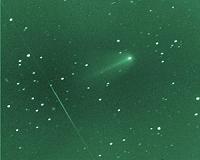 Ikeya-Murakami: The New Comet On The Cosmic Block
Huntsville AL (SPX) Nov 18, 2010 The animation below shows the motion of Comet Ikeya-Murakami on Nov. 13, 2010, captured with a New Mexico-based telescope operated remotely by NASA's Marshall Space Flight Center. The images were taken near dawn and show the comet's movement over a period of 45 minutes. Each exposure was three minutes in length, and the faint angled streak around 0:10 in the animation is a satellite ... read more |
|
|
| The content herein, unless otherwise known to be public domain, are Copyright 1995-2010 - SpaceDaily. AFP and UPI Wire Stories are copyright Agence France-Presse and United Press International. ESA Portal Reports are copyright European Space Agency. All NASA sourced material is public domain. Additional copyrights may apply in whole or part to other bona fide parties. Advertising does not imply endorsement,agreement or approval of any opinions, statements or information provided by SpaceDaily on any Web page published or hosted by SpaceDaily. Privacy Statement |


 del.icio.us
 Digg
Digg Reddit
 YahooMyWeb
 Google
 Facebook


