|
 |
 |
 |
 |
 |
 |
 |

| . |  |
. |

|
|
. |

 by Staff Writers Munich, Germany (SPX) Jun 20, 2011
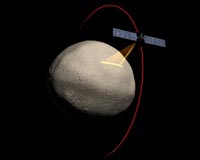
While NASA's space probe Dawn is continuing its approach towards Vesta, the camera system on board is beginning to show the giant asteroid in more and more detail. The newest pictures taken on June 1st and processed by researchers at the Max Planck Institute for Solar System Research (MPS) in Germany already hint at the huge crater on Vesta's southern hemisphere that is known from earlier observations. In addition, the new images show a dark feature close to the asteroids's equator. "Vesta is coming more and more into focus", says Dr. Andreas Nathues from MPS, Framing Camera Lead Investigator. In this early approach phase the images mainly serve navigational purposes. The images that were obtained on June 1st and carefully processed at MPS now for the first time show a dark feature with a diameter of approximately 100 kilometers near the asteroid's equator. "We won't know what this dark spot is for a few weeks, when we have come a bit closer to the asteroid", Dr. Vishnu Reddy and Dr. Lucille Le Corre from MPS explain. Both scientists analyzed the data received from the Dawn framing camera. Older images taken by NASA's Hubble Space Telescope had revealed a similar structure. "In the current images one pixel corresponds to 45 kilometers on Vesta's surface", explains Dr. Holger Sierks from MPS, one of the mission's Co-Investigators. The resolution is approaching the resolution of the best Hubble images of Vesta. "In the next weeks we will see Vesta in a way no one has ever before", says Sierks. The space probe is expected to go into orbit around Vesta on July 16th and then accompany the asteroid for about a year. Vesta circles the Sun between the orbits of Mars and Jupiter within the so-called asteroid belt. The Dawn mission to Vesta and Ceres is managed by the Jet Propulsion Laboratory, for NASA's Science Mission Directorate, Washington, D.C. It is a project of the Discovery Program managed by NASA's Marshall Space Flight Center, Huntsville, Ala. The University of California in Los Angeles is responsible for overall Dawn mission science. Orbital Sciences Corp. of Dulles, Va., designed and built the spacecraft. The framing cameras were developed and built under the leadership of the Max Planck Institute for Solar System Research in Katlenburg-Lindau in Germany, with significant contributions by the German Aerospace Center (DLR) Institute of Planetary Research in Berlin and in coordination with the Institute of Computer and Communication Network Engineering in Braunschweig. The framing camera project is funded by NASA, the Max Planck Society and DLR.
|
. |
|
| The content herein, unless otherwise known to be public domain, are Copyright 1995-2011 - Space Media Network. AFP and UPI Wire Stories are copyright Agence France-Presse and United Press International. ESA Portal Reports are copyright European Space Agency. All NASA sourced material is public domain. Additional copyrights may apply in whole or part to other bona fide parties. Advertising does not imply endorsement,agreement or approval of any opinions, statements or information provided by Space Media Network on any Web page published or hosted by Space Media Network. Privacy Statement |

 del.icio.us
 Digg
Digg Reddit
 Google