
 |
 |
 |
 |
 |
 |
 |
 |
 |
 |

| . |  |
. |

Beijing, China (SPX) Dec 06, 2010 Physicists at the Institute of Theoretical Physics, Chinese Academy of Sciences and the Department of Physics at Northeastern University have made a comparison of a number of competing dark energy models. They have tested and compared nine popular dark energy models using the latest observational data. The study is reported in Issue 9 (Volume 53) of Science China Physics, Mechanics and Astronomy because of its significant research value. Over the past decade, cosmologists around the world have accumulated conclusive evidence for the fact that the cosmic expansion is accelerating. Within the framework of the standard cosmological model, this implies that about two-thirds of the cosmos is composed of an exotic component, "dark energy", which, unlike any known form of matter or energy, is gravitationally repulsive. To explain the gravitationally repulsive dark energy, physicists and cosmologists have proposed a variety of theoretical models. However, none of them are commonly accepted as the convincing theoretical explanation for dark energy. Understanding the nature of dark energy continues to be one of the major missions for fundamental physics. In the absence of clear theoretical guidance, the physics community is reliant on comparison to observational data in selecting a correct dark energy model. In this work, nine popular dark energy models are tested and compared using the latest observational data, which includes type Ia supernovae, baryon acoustic oscillation, and cosmic microwave background. The models under consideration are the cosmological constant (CC) model, two equation of state parameterization models, the generalized Chaplygin gas model, two Dvali-Gabadadze-Porrati models, and three holographic dark energy models. All of these models are well-known dark energy candidates and have attracted considerable attention in the past. The dark energy models have been fitted to the observational data. In this procedure, each model is assessed with a number called the IC value. Statistically, a model with fewer parameters and with a better fit to the data has a lower IC value. The models under consideration have been compared and ranked according to their IC values. Consequently, it has been found that the CC model fits the observational data best. In addition to the CC model, five other models also provide a good fit to the current data, while the remaining three models, a Dvali-Gabadadze-Porrati model and two holographic models, clearly do not fit the observational data well. (For simplicity, we call them the five good models and the three bad models.) It is interesting to note that four of the five good models are closely related to the CC model, which may be the reason they fit the data so well, while none of the bad models can be reduced to the CC model. Furthermore, it is interesting to note that there is one holographic dark energy model, which is not reducible to the CC model, yet it still provides a good fit to the current observational data. This model was proposed by Professor Miao Li, one of the authors of this work. As the name implies, this holographic dark energy model arises from the holographic principle of quantum gravity. The holographic principle determines the range of validity for a local effective quantum field theory to be an accurate description of the world involving dark energy by imposing a relationship between the ultraviolet and infrared cut-offs. In his well-known article, "A Model of Holographic Dark Energy", Li has shown that a form of holographic dark energy emerges if the future event horizon size of the universe is chosen as the infrared cut-off scale in the effective quantum field theory. In summary, the CC model is still the best candidate for dark energy, according to the results from fitting models to current observational data. The authors concluded that "Given the current quality of the observational data, and with the assumption of a flat universe, information criteria indicate that the cosmological constant model is still the best one and there is no reason to prefer any more complex model". However, as new observations are made, it is possible that the preferred model could change. It is important to keep in mind that there are limitations associated with the current observational data. To precisely determine the nature of dark energy, an improvement in the accuracy of data is of essential importance. "We look forward to seeing whether this conclusion [that the CC model is the best candidate for dark energy] can be changed by future more accurate data," said the authors in the final statement of the paper. This work was supported by the National Natural Science Foundation of China (Grant Nos. 10705041, 10821504, 10975032 and 10975172), and the National Basic Research Program of China (Grant No. 2007CB815401). Li M, Li X.D. and Zhang X. SCIENCE CHINA Physics, Mechanics and Astronomy 2010; 53: 1631-1645
Share This Article With Planet Earth
Related Links Science in China Press Stellar Chemistry, The Universe And All Within It

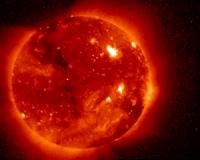 Dark Matter Could Transfer Energy In The Sun
Valencia, Spain (SPX) Dec 03, 2010 Researchers from the Institute for Corpuscular Physics (IFIC) and other European groups have studied the effects of the presence of dark matter in the Sun. According to their calculations, low mass dark matter particles could be transferring energy from the core to the external parts of the Sun, which would affect the quantity of neutrinos that reach the Earth. "We assume that the dark mat ... read more |
|
|
| The content herein, unless otherwise known to be public domain, are Copyright 1995-2010 - SpaceDaily. AFP and UPI Wire Stories are copyright Agence France-Presse and United Press International. ESA Portal Reports are copyright European Space Agency. All NASA sourced material is public domain. Additional copyrights may apply in whole or part to other bona fide parties. Advertising does not imply endorsement,agreement or approval of any opinions, statements or information provided by SpaceDaily on any Web page published or hosted by SpaceDaily. Privacy Statement |


 del.icio.us
 Digg
Digg Reddit
 YahooMyWeb
 Google
 Facebook


