|
 |
 |
 |
 |
 |
 |
 |
 |
 |

| . |  |
. |
Conceptualizing A Cyborg
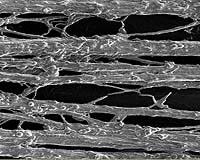
University Park (SPX) Jan 23, 2007 Investigators at the University of Pennsylvania School of Medicine describe the basis for developing a biological interface that could link a patient's nervous system to a thought-driven artificial limb. Their conceptual framework - which brings together years of spinal-cord injury research - is published in the January issue of Neurosurgery. "We're at a junction now of developing a new approach for a brain-machine interface," says senior author Douglas H. Smith, MD, Professor of Neurosurgery and Director of the Center for Brain Injury and Repair at Penn. "The nervous system will certainly rebel if you place hard or sharp electrodes into it to record signals. However, the nervous system can be tricked to accept an interface letting it do what it likes - assimilating new nerve cells into its own network." To develop the next generation of prosthetics the idea is to use regions of undamaged nervous tissue to provide command signals to drive a device, such as an artificial limb. The challenge is for a prosthesis to perform naturally, relaying two-way communication with the patient's brain. For example, the patient's thoughts could convert nerve signals into movements of a prosthetic, while sensory stimuli, such as temperature or pressure provides feedback to adapt the movements. The central feature of the proposed interface is the ability to create transplantable living nervous tissue already coupled to electrodes. Like an extension cord, of sorts, the non-electrode end of the lab-grown nervous tissue could integrate with a patient's nerve, relaying the signals to and from the electrode side, in turn connected to an electronic device. This system may one day be able to return function to people who have been paralyzed by a spinal-cord injury, lost a limb, or in other ways. "Whether it is a prosthetic device or a disabled body function, the mind could regain control," says Smith. To create the interface, the team used a newly developed process of stretch growth of nerve fibers called axons, previously pioneered in Smith's lab. Two adjacent plates of neurons are grown in a bioreactor. Axons sprout out to connect the neuron populations on each plate. The plates are then slowly pulled apart over a series of days, aided by a precise computer-controlled motor system, until they reached a desired length. For the interface, one of the plates is an electrical microchip. Because Smith and his team have shown that stretch-grown axons can transmit active electrical signals, they propose that the nervous-tissue interface - through the microchip - could detect and record real-time signals conducted down the nerve and stimulate the sensory signals back through the axons. In another study, Smith and colleagues showed that these stretch-grown axons could grow when transplanted into a rat model of spinal-cord damage. The team is now is the midst of studies measuring neuronal electrical activity across newly engineered nerve bridges and the restoration of motor activity in experimental animals. Co-authors are Niranjan Kameswaran, and Eric L. Zager, all from Penn and Bryan J. Pfister, New Jersey Institute of Technology (Newark, NJ), and Jason Huang at the University of Rochester, N.Y. Related Links University of Pennsylvania All about the robots on Earth and beyond!  Hunt On For Next World-Changing Gadget At US Electronics Show
 Las Vegas (AFP) Nevada, Jan 7, 2007
People are snapping up new technology, altering the fabric of society from the heart of the home to the driver's seat, the organizer of the world's largest consumer electronics show said here Saturday. Sales of consumer electronics from manufacturers to retailers in the United States is expected to surpass 155 billion dollars in 2007, a six percent rise from 2006, according to the Consumer Electronics Association (CEA). |
|
|

| The content herein, unless otherwise known to be public domain, are Copyright 1995-2006 - SpaceDaily.AFP and UPI Wire Stories are copyright Agence France-Presse and United Press International. ESA PortalReports are copyright European Space Agency. All NASA sourced material is public domain. Additionalcopyrights may apply in whole or part to other bona fide parties. Advertising does not imply endorsement,agreement or approval of any opinions, statements or information provided by SpaceDaily on any Web page published or hosted by SpaceDaily. Privacy Statement |