
 |
 |
 |
 |
 |
 |
 |
 |
 |
 |

| . |  |
. |

Washington DC (SPX) Nov 10, 2010 NASA's Wide-field Infrared Survey Explorer, or WISE, has eyed its first cool brown dwarf: a tiny, ultra-cold star floating all alone in space. WISE is scanning the whole sky in infrared light, picking up the glow of not just brown dwarfs but also asteroids, stars and galaxies. It has sent millions of images down to Earth, in which infrared light of different wavelengths is color-coded in the images. "The brown dwarfs jump out at you like big, fat, green emeralds," said Amy Mainzer, the deputy project scientist of WISE at NASA's Jet Propulsion Laboratory in Pasadena, Calif. Mainzer, who makes jewelry in her spare time, explained that the brown dwarfs appear like green gems in WISE images because the methane in their atmospheres absorbs the infrared light that has been coded blue, and because they are too faint to give off the infrared light that is color-coded red. The only color left is green. Like Jupiter, brown dwarfs are made up of gas - a lot of it in the form of methane, hydrogen sulfide, and ammonia. These gases would be deadly to humans at the concentrations found around brown dwarfs. And they wouldn't exactly smell pretty. "If you could bottle up a gallon of this object's atmosphere and bring it back to Earth, smelling it wouldn't kill you, but it would stink pretty badly - like rotten eggs with a hint of ammonia," said Mainzer. Mainzer and other members of the WISE team are already accumulating a quarry of brown dwarf candidates similar to this one. Brown dwarfs have masses somewhere between those of a star and a planet. They start out like stars as collapsing balls of gas, but they lack the mass to fuse atoms together at their core and shine with starlight. As time goes on, these lightweights cool off, until they can only be seen in infrared light. There could be many such objects lurking in the neighborhood of our sun, but astronomers know of only a handful so far. WISE is expected to find hundreds, including the coolest and closest of all. To scientists, brown dwarfs represent the perfect laboratories for studying planet-like atmospheres. "They're a great test of our understanding of atmospheric physics of planets, since they don't have solid surfaces, and there's no big, bright sun to get in the way," said co-author Michael Cushing, a postdoctoral fellow at JPL. WISE's new brown dwarf is named WISEPC J045853.90+643451.9 for its location in the sky. It is estimated to be 18 to 30 light-years away and is one of the coolest brown dwarfs known, with a temperature of about 600 Kelvin, or 620 degrees Fahrenheit. That's downright chilly as far as stars go. The fact that this brown dwarf jumped out of the data so easily and so quickly - it was spotted 57 days into the survey mission - indicates that WISE will discover many, many more. The discovery was confirmed by follow-up observations at the University of Virginia's Fan Mountain telescope, the Large Binocular Telescope in southeastern Arizona, and NASA's Infrared Telescope Facility on Mauna Kea, Hawaii. The results are in press at the Astrophysical Journal.
Share This Article With Planet Earth
Related Links Wise at NASA Wise at UCLA Stellar Chemistry, The Universe And All Within It

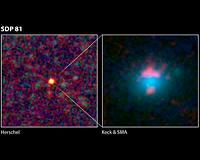 Herschel's Hidden Talent: Digging Up Magnified Galaxies
Pasadena CA (JPL) Nov 05, 2010 It turns out the Herschel Space Observatory has a trick up its sleeve. The telescope, a European Space Agency mission with important NASA contributions, has proven to be excellent at finding magnified, faraway galaxies. Like little kids probing patches of dirt for insects, astronomers can use these new cosmic magnifying lenses to study galaxies that are hidden in dust. "I was surprised to ... read more |
|
|
| The content herein, unless otherwise known to be public domain, are Copyright 1995-2010 - SpaceDaily. AFP and UPI Wire Stories are copyright Agence France-Presse and United Press International. ESA Portal Reports are copyright European Space Agency. All NASA sourced material is public domain. Additional copyrights may apply in whole or part to other bona fide parties. Advertising does not imply endorsement,agreement or approval of any opinions, statements or information provided by SpaceDaily on any Web page published or hosted by SpaceDaily. Privacy Statement |


 del.icio.us
 Digg
Digg Reddit
 YahooMyWeb
 Google
 Facebook


