|
 |
 |
 |
 |
 |
 |
 |
 |
 |

| . |  |
. |
Cornell Caltech Atacama Telescope project To Revolutionize Astronomy
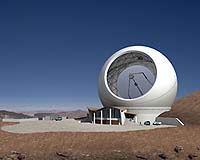
Ithaca NY (SPX) May 18, 2007 In a major step forward for the Cornell Caltech Atacama Telescope (CCAT), a proposed 25-meter aperture telescope that will be the largest, most precise and highest astronomical facility in the world, participants announced this week that two more institutions have signed an interim agreement to join the CCAT consortium. The two, the University of Colorado at Boulder and the United Kingdom Astronomy Technology Centre, which is a facility of the Science and Technology Facilities Council, have committed to pursue formal partnership and to identify the sources for full funding of the project. The $100 million telescope, to be built in the Cerro Chajnantor in the Atacama Desert region in Chile, will take advantage of the rapid development in bolometer array technology (instruments that measures radiant energy) to answer some of the most fundamental questions of cosmology. Under the guidance of Riccardo Giovanelli, Cornell professor of astronomy and CCAT director, and with private funding from retired businessman Fred Young '64, Cornell signed an agreement with the California Institute of Technology (Caltech) in 2004 to collaborate on the project. Cornell and Caltech remain the project's principal institutions, with each responsible for 25 percent of the cost. Planners hope to begin construction this year and to see first light in 2013. "CCAT is designed to optimize our ability to study the genesis of structures in the universe," said Giovanelli. "It will allow us to explore the process of formation of galaxies, which saw its heyday about a billion years after the big bang, some 13 billion years ago; to peek into the interior of the dusty molecular clouds within which stars and planets form; and to survey the pristine chunks of material left intact for billions of years on the outskirts of our solar system." The telescope will also be a powerful survey tool, working 30 times faster than current facilities and with much greater sensitivity. Large-scale surveys of extremely distant galaxies could give scientists a better understanding of how galaxies were distributed as they formed and how their clustering properties evolved. Radiation at submillimeter wavelengths (longer than visible light but shorter than radio waves) is normally difficult to detect from the ground because it is easily absorbed by water in the Earth's atmosphere. The Atacama Desert's dry climate and 5,600-meter (about 3.5 miles) altitude make it a unique and ideal spot for ground-based far-infrared astronomy. Project scientists are Terry Herter, Cornell professor of astronomy, and Jonas Zmuidzinas, professor of physics at Caltech. Gordon Stacey, Cornell professor of astronomy, is the project's instrumentation scientist, and Cornell researcher and engineer Thomas Sebring is project manager. "Over the past two years CCAT has made excellent progress in developing scientific instrument designs and strengthening the case for construction," said Sebring. "CCAT will provide access to astronomical data which is currently unavailable." An independent blue-ribbon panel of scientists reviewed the CCAT proposal in 2006 and gave it high marks. "CCAT will revolutionize astronomy ... and enable significant progress in unraveling the cosmic origin of stars, planets and galaxies," the panel wrote. "CCAT is very timely and cannot wait." Email This Article
Related Links  Washington DC (SPX) May 05, 2007
This May, there will be more than one "web slinger" coming to town. In addition to the superhero, who will make his third movie appearance, NASA has its own "Webb" slinger - the James Webb Space Telescope. The Webb space telescope will be much larger than the Hubble Space Telescope, its predecessor. A life-sized model of the "Webb" telescope is coming to the National Mall, Washington. |
|
|

| The content herein, unless otherwise known to be public domain, are Copyright 1995-2006 - SpaceDaily.AFP and UPI Wire Stories are copyright Agence France-Presse and United Press International. ESA PortalReports are copyright European Space Agency. All NASA sourced material is public domain. Additionalcopyrights may apply in whole or part to other bona fide parties. Advertising does not imply endorsement,agreement or approval of any opinions, statements or information provided by SpaceDaily on any Web page published or hosted by SpaceDaily. Privacy Statement |