
 |
 |
 |
 |
 |
 |
 |
 |
 |
 |

| . |  |
. |

Los Angeles CA (SPX) Aug 20, 2010 Physicists from UCLA and Japan have discovered evidence of "natural nuclear accelerators" at work in our Milky Way galaxy, based on an analysis of data from the world's largest cosmic ray detector. Cosmic rays of the highest energies were believed by physicists to come from remote galaxies containing enormous black holes capable of consuming stars and accelerating protons at energies comparable to that of a bullet shot from a rifle. These protons - referred to individually as "cosmic rays" - travel through space and eventually enter our galaxy. But earlier this year, physicists using the Pierre Auger Observatory in Argentina, the world's largest cosmic ray observatory, published a surprising discovery: Many of the energetic cosmic rays found in the Milky Way are not actually protons but nuclei - and the higher the energy, the greater the nuclei-to-proton ratio. "This finding was totally unexpected because the nuclei, more fragile than protons, tend to disintegrate into protons on their long journey through space," said Alexander Kusenko, UCLA professor of physics and astronomy and co-author of the Physical Review Letters research. "Moreover, it is very unlikely that a cosmic accelerator of any kind would accelerate nuclei better than protons at these high energies." The resolution to the paradox of the nuclei's origin comes from an analysis by Kusenko; Antoine Calvez, a UCLA graduate student of physics who is part of Kusenko's research group; and Shigehiro Nagataki, an associate professor of physics at Japan's Kyoto University. They found that stellar explosions in our own galaxy can accelerate both protons and nuclei. But while the protons promptly leave the galaxy, the heavier and less mobile nuclei become trapped in the turbulent magnetic field and linger longer. "As a result, the local density of nuclei is increased, and they bombard Earth in greater numbers, as seen by the Pierre Auger Observatory," said Kusenko, who is also a senior scientist at the University of Tokyo's Institute for Physics and Mathematics of the Universe (IPMU). These ultra-high-energy nuclei have been trapped in the web of galactic magnetic fields for millions of years, and their arrival directions as they enter the Earth's atmosphere have been "completely randomized by numerous twists and turns in the tangled field," he said. "When the data came out, they were so unexpected that many people started questioning the applicability of known laws of physics at high energy," Kusenko said. "The common lore has been that all ultra-high-energy cosmic rays must come from outside the galaxy. The lack of plausible sources and the lack of preference in the direction of the galactic center have been used as arguments in favor of extragalactic sources. "However, since the cosmic rays in question turned out to be nuclei, the galactic field can randomize their arrival directions, taking care of the anisotropy puzzle. As for the plausible sources, the enormous stellar explosions responsible for gamma ray bursts can accelerate nuclei to high energies. When we put these two together, we knew we were on the right track. Then we calculated the spectra and the asymmetries, and both agreed with the data very well." Kusenko hopes this research will enhance the understanding of "astrophysical archeology." "We can study the collective effects of gamma ray bursts that have taken place in the past of our own galaxy over millions of years," he said. Stellar explosions capable of accelerating particles to ultra-high energies have been seen in other galaxies, where they produce gamma-ray bursts. The new analysis provides evidence that such powerful explosions occur in our galaxy as well, at least a few times per million years, Kusenko said. Kusenko and his colleagues predict that the protons escaping from other galaxies should still be seen at the highest energies and should point back to their sources, providing Pierre Auger Observatory with valuable data. The Pierre Auger Observatory records cosmic ray showers through an array of 1,600 particle detectors placed about one mile apart in a grid spread across 1,200 square miles, complemented by specially designed telescopes. The observatory is named for the French physicist Pierre Victor Auger, who in the 1920s discovered air showers. Kusenko's research was federally funded by the U.S. Department of Energy and NASA. Nagataki's research was funded by the Japan Society for the Promotion of Science.
Share This Article With Planet Earth
Related Links UCLA Stellar Chemistry, The Universe And All Within It

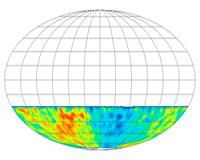 IceCube Spies Unexplained Pattern Of Cosmic Rays
Madison WI (SPX) Jul 29, 2010 Though still under construction, the IceCube Neutrino Observatory at the South Pole is already delivering scientific results - including an early finding about a phenomenon the telescope was not even designed to study. IceCube captures signals of notoriously elusive but scientifically fascinating subatomic particles called neutrinos. The telescope focuses on high-energy neutrinos that trav ... read more |
|
|
| The content herein, unless otherwise known to be public domain, are Copyright 1995-2010 - SpaceDaily. AFP and UPI Wire Stories are copyright Agence France-Presse and United Press International. ESA Portal Reports are copyright European Space Agency. All NASA sourced material is public domain. Additional copyrights may apply in whole or part to other bona fide parties. Advertising does not imply endorsement,agreement or approval of any opinions, statements or information provided by SpaceDaily on any Web page published or hosted by SpaceDaily. Privacy Statement |


 del.icio.us
 Digg
Digg Reddit
 YahooMyWeb
 Google
 Facebook


