
 |
 |
 |
 |
 |
 |
 |
 |
 |
 |

| . |  |
. |

Chicago IL (SPX) Nov 24, 2010 Astronomers find cosmic dust annoying when it blocks their view of the heavens, but without it the universe would be devoid of stars. Cosmic dust is the indispensable ingredient for making stars and for understanding how primordial diffuse gas clouds assemble themselves into full-blown galaxies. "Formation of galaxies is one of the biggest remaining questions in astrophysics," said Andrey Kravtsov, associate professor in astronomy and astrophysics at the University of Chicago. Astrophysicists are moving closer to answering that question, thanks to a combination of new observations and supercomputer simulations, including those conducted by Kravtsov and Nick Gnedin, a physicist at Fermi National Accelerator Laboratory. Gnedin and Kravtsov published new results based on their simulations in the May 1, 2010 issue of The Astrophysical Journal, explaining why stars formed more slowly in the early history of the universe than they did much later. The paper quickly came to the attention of Robert C. Kennicutt Jr., director of the University of Cambridge's Institute of Astronomy and co-discoverer of one of the key observational findings about star formation in galaxies, known as the Kennicutt-Schmidt relation. In the June 3, 2010 issue of Nature, Kennicutt noted that the recent spate of observations and theoretical simulations bodes well for the future of astrophysics. In their Astrophysical Journal paper, Kennicutt wrote, "Gnedin and Kravtsov take a significant step in unifying these observations and simulations, and provide a prime illustration of the recent progress in the subject as a whole."
Star-formation law The relation has been quite useful when applied to galaxies observed late in the history of the universe, but recent observations by Arthur Wolfe of the University of California, San Diego, and Hsiao-Wen Chen, assistant professor in astronomy and astrophysics at UChicago, indicate that the relation fails for galaxies observed during the first two billion years following the big bang. Gnedin and Kravtsov's work successfully explains why. "What it shows is that at early stages of evolution, galaxies were much less efficient in converting their gas into stars," Kravtsov said. Stellar evolution leads to increasing abundance of dust, as stars produce elements heavier than helium, including carbon, oxygen, and iron, which are key elements in dust particles. "Early on, galaxies didn't have enough time to produce a lot of dust, and without dust it's very difficult to form these stellar nurseries," Kravtsov said. "They don't convert the gas as efficiently as galaxies today, which are already quite dusty." The star-formation process begins when interstellar gas clouds become increasingly dense. At some point the hydrogen and helium atoms start combining to form molecules in certain cold regions of these clouds. A hydrogen molecule forms when two hydrogen atoms join. They do so inefficiently in empty space, but find each other more readily on the surface of a cosmic dust particle. "The biggest particles of cosmic dust are like the smallest particles of sand on good beaches in Hawaii," Gnedin said. These hydrogen molecules are fragile and easily destroyed by the intense ultraviolet light emitted from massive young stars. But in some galactic regions dark clouds, so-called because of the dust they contain, form a protective layer that protects the hydrogen molecules from the destructive light of other stars.
Stellar nurseries "There is a simple connection between the presence of dust in this diffuse gas and its ability to form stars, and that's something that we modeled for the first time in these galaxy-formation simulations," Kravtsov said. "It's very plausible, but we don't know for sure that that's exactly what's happening." The Gnedin-Kravtsov model also provides a natural explanation for why spiral galaxies predominately fill the sky today, and why small galaxies form stars slowly and inefficiently. "We usually see very thin disks, and those types of systems are very difficult to form in galaxy-formation simulations," Kravtsov said. That's because astrophysicists have assumed that galaxies formed gradually through a series of collisions. The problem: simulations show that when galaxies merge, they form spheroidal structures that look more elliptical than spiral. But early in the history of the universe, cosmic gas clouds were inefficient at making stars, so they collided before star formation occurred. "Those types of mergers can create a thin disk," Kravtsov said. As for small galaxies, their lack of dust production could account for their inefficient star formation. "All of these separate pieces of evidence that existed somehow all fell into one place," Gnedin observed. "That's what I like as a physicist because physics, in general, is an attempt to understand unifying principles behind different phenomena." More work remains to be done, however, with input from newly arrived postdoctoral fellows at UChicago and more simulations to be performed on even more powerful supercomputers. "That's the next step," Gnedin said.
Share This Article With Planet Earth
Related Links University of Chicago Stellar Chemistry, The Universe And All Within It

 New Evidence For Supernova-Driven Galactic Fountains In Milky Way
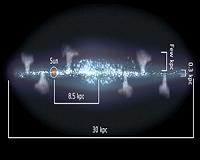
Paris, France (ESA) Nov 22, 2010 Observing the X-ray-bright gas in the halo of the Milky Way, ESA's XMM-Newton has gathered new data which favour a process involving fountains of hot gas in our Galaxy. Such a scenario, with the gas flowing from the galactic disc into the halo where it then condenses into cooler clouds and subsequently falls back to the disc, confirms the importance of supernova explosions in forging the e ... read more |
|
|
| The content herein, unless otherwise known to be public domain, are Copyright 1995-2010 - SpaceDaily. AFP and UPI Wire Stories are copyright Agence France-Presse and United Press International. ESA Portal Reports are copyright European Space Agency. All NASA sourced material is public domain. Additional copyrights may apply in whole or part to other bona fide parties. Advertising does not imply endorsement,agreement or approval of any opinions, statements or information provided by SpaceDaily on any Web page published or hosted by SpaceDaily. Privacy Statement |


 del.icio.us
 Digg
Digg Reddit
 YahooMyWeb
 Google
 Facebook


