|
 |
 |
 |
 |
 |
 |
 |

| . |  |
. |

|
|
. |

 by Staff Writers Paris (AFP) June 8, 2011
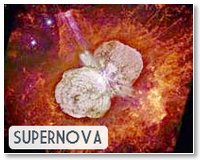
Astronomers on Wednesday reported that six ultra-bright flashes detected in deep space were ancient exploding stars that are a new kind of supernova. "We have a whole new class of objects that can't be explained by any of the models we've seen before," said Robert Quimby of the California Institute of Technology (Caltech) who led the probe into the strange explosions. Most supernovae occur when a very massive star runs out of fuel, its core collapses and then explodes, leaving behind a neutron star or a black hole. There is also a rarer kind in which mass flows from a cooling ageing star called a red star to a "white dwarf," the hot and dense core of an old star, which eventually collapses in on itself and then explodes. But six supernovae observed by Quimby and his team had none of the chemical signatures of these known supernovae. The investigation began in 2005, when Quimby spotted a supernova called SN 2005ap that was 100 billion times brighter than the Sun and turned out to be twice as bright as the previous record-holder. At about the same time, the Hubble Space Telescope found a supernova, also with an odd chemical spectrum, called SCP 06F6. That sparked the formation of a special team to scan the skies for "transients," as ephemeral flashes are called, but combining the optical power of hefty telescopes in California, Hawaii and the Canary Island. Four new objects were added to the supernova net, all with the unusual, hydrogen-less signature. They were found in small galaxies of a few billion stars known as dwarf galaxies. Reporting in the British science journal Nature, the team say that the new supernovae are extremely hot, reaching temperatures of 20,000 degrees Celsius (36,000 degrees Fahrenheit) and their blastwave travels through space at around 10,000 kilometres (6,000 miles) per second. In addition, they take a long time to fade -- some 50 days, compared with a few days or several weeks for "ordinary" supernovae, whose brightness is governed by radioactive decay. Still unanswered, though, is what causes the brightness. One idea is the source is a "pulsating" star, a very large star that blows off hydrogen-free shells of gas. When the star eventually explodes as a supernova, the blast heats up the shells to searing temperatures, and this causes the luminosity. "These new supernovae are very interesting, because they are 10 times more brilliant than the others and allow us to delve further in space and time... back to the first 10 percent of the age of the Universe," said French astronomer Francoise Combes in a comment.
|
. |
|
| The content herein, unless otherwise known to be public domain, are Copyright 1995-2011 - Space Media Network. AFP and UPI Wire Stories are copyright Agence France-Presse and United Press International. ESA Portal Reports are copyright European Space Agency. All NASA sourced material is public domain. Additional copyrights may apply in whole or part to other bona fide parties. Advertising does not imply endorsement,agreement or approval of any opinions, statements or information provided by Space Media Network on any Web page published or hosted by Space Media Network. Privacy Statement |

 del.icio.us
 Digg
Digg Reddit
 Google