
 |
 |
 |
 |
 |
 |
 |
 |
 |
 |

| . |  |
. |

Science@NASA Huntsville AL (SPX) Aug 20, 2010 Let the countdown begin. NASA's Dawn spacecraft is less than one year away from giant asteroid Vesta. There's nothing more exciting than revealing an unexplored, alien world," says Marc Rayman, Dawn's chief engineer at the Jet Propulsion Laboratory. "Vesta," he predicts, "is going to amaze us." Dawn is slated to enter orbit around Vesta in late July 2011. As the first breathtaking images are beamed back to Earth, researchers will quickly combine them into a movie, allowing us all to ride along. "It will look as though the spacecraft is hovering in one place while Vesta rotates beneath it," says Rayman. Previous missions have shown us a handful of asteroids, but none as large as this hulking relic of the early solar system. Measuring 350 miles across and containing almost 10% of the mass of the entire asteroid belt, Vesta is a world unto itself. "It's a big, rocky, terrestrial type body - more likely similar to the moon and Mercury than to the little chips of rocks we've flown by in the past," continues Rayman. "For example, there's a large crater at Vesta's south pole, and inside the crater is a mountain bigger than asteroid Eros." Dawn will orbit Vesta for a year, conducting a detailed study and becoming the first spacecraft to ever orbit a body in the asteroid belt. Later, Dawn will leave Vesta and go on to orbit a second exotic world, dwarf planet Ceres--but that's another story. Many scientists consider Vesta a protoplanet. The asteroid was in the process of forming into a full fledged planet when Jupiter interrupted its growth. The gas giant became so massive that its gravity stirred up the material in the asteroid belt so the objects there could no longer coalesce. "Vesta can teach us a lot about how planets formed," says Christopher Russell of UCLA, the mission's Principal Investigator. "There is a whole team of scientists sitting on the edge of their seats waiting for that first glimpse of Vesta." Dawn's official Vestian approach, which Rayman also calls the "oh man this is so cool phase" of the mission, begins next May. Unlike most orbital insertions, however, this one will be comparatively relaxing. "This may be the first planetary mission that doesn't cause its mission team members to bite their nails while their spacecraft is getting into planetary orbit," says Rayman. A conventional spacecraft's entry into a flight path around a celestial body is accompanied by crucial periods during which maneuvers must be executed with pinpoint precision. If anything goes wrong, all can be lost. But Dawn, with its gentle ion propulsion, slowly spirals in to its target, getting closer and closer as it loops around. "Dawn's entire thrust profile for its long interplanetary flight has been devoted largely to the gradual reshaping of its orbit around the Sun so that by the time the spacecraft is in the vicinity of Vesta, its orbit will be very much like Vesta's." With just a slight change in trajectory, the spacecraft will allow itself to be captured by Vesta's gravity. "Even that gentle ion thrust will be quite sufficient to let the craft slip into orbit. It's like merging into traffic on an interstate - only gradual acceleration is needed. Dawn won't even notice the difference, but it will be in orbit around its first celestial target." Dawn's first survey orbits will be high and leisurely, taking days to loop around Vesta at altitudes of about 1700 miles. After collecting a rich bounty of pictures and data from high altitude, Dawn will resume thrusting, spiraling down to lower and lower orbits, eventually settling in a little more than 100 miles high--lower than satellites orbiting Earth. Parts of the surface may be reminiscent of features on Earth or the Moon with craters and perhaps even volcanoes. "We don't expect to see active volcanoes," notes Carol Raymond, the mission's Deputy Principal Investigator at JPL, "but there could be ancient volcanic features still recognizable among the craters." Meanwhile, "other sights could be completely unlike anything we've imagined," says Rayman. "It'll be pure excitement!"
Share This Article With Planet Earth
Related Links Dawn Asteroid and Comet Mission News, Science and Technology

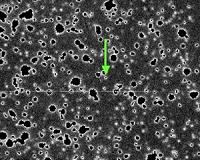 Asteroid Found In Gravitational Dead Zone
Washington DC (SPX) Aug 13, 2010 There are places in space where the gravitational tug between a planet and the Sun balance out, allowing other smaller bodies to remain stable. These places are called Lagrangian points. So-called Trojan asteroids have been found in some of these stable spots near Jupiter and Neptune. Trojans share their planet's orbit and help astronomers understand how the planets formed and how the sola ... read more |
|
|
| The content herein, unless otherwise known to be public domain, are Copyright 1995-2010 - SpaceDaily. AFP and UPI Wire Stories are copyright Agence France-Presse and United Press International. ESA Portal Reports are copyright European Space Agency. All NASA sourced material is public domain. Additional copyrights may apply in whole or part to other bona fide parties. Advertising does not imply endorsement,agreement or approval of any opinions, statements or information provided by SpaceDaily on any Web page published or hosted by SpaceDaily. Privacy Statement |


 del.icio.us
 Digg
Digg Reddit
 YahooMyWeb
 Google
 Facebook


