|
 |
 |
 |
 |
 |
 |
 |
 |
 |

| . |  |
. |
Counting The Craters Of Mercury Begins
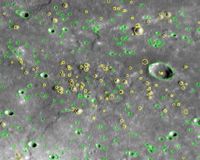
Laurel MD (SPX) Jan 28, 2008 On January 14, 2008, MESSENGER flew by Mercury and snapped images of a large portion of the surface that had not been previously seen by spacecraft. Ever since the first images were received back on Earth one day later, January 15, MESSENGER team members have been closely examining and studying this "new" terrain with great interest and excitement. One of many investigations underway includes identifying and measuring the impact craters on these previously unseen regions. The density of craters on the surface of a planet can be used to indicate the relative age of different places on the surface; the more craters the surface has accumulated, the older the surface. By counting craters on different areas of Mercury's surface, a relative geologic history of the planet can be constructed, indicating which surfaces formed first and which formed later. However, this process is also time consuming; Mercury has a lot of craters! Of course, simply counting the craters is not enough. Each crater has to be measured and classified to fully interpret the differences in crater density. Many small craters form as "secondaries," as clumps of material ejected from a "primary" crater re-impact the surface in the regions surrounding the primary. In order to learn about the history of asteroid and comet impacts on Mercury, scientists have to distinguish between the primary and secondary craters. Once many more craters are measured, MESSENGER researchers will have new insights into the geological history of Mercury. Community Email This Article Comment On This Article Related Links Messenger at APL News Flash at Mercury Mars News and Information at MarsDaily.com Lunar Dreams and more
 Mercurial Colors Makes For Subtle Eye Candy
 Laurel MD (APL) Jan 22, 2008
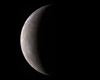
One week ago, the Messenger spacecraft transmitted to Earth the first high-resolution image of Mercury by a spacecraft in over 30 years since the three Mercury flybys of Mariner 10 in 1974 and 1975. Messenger's Wide Angle Camera (WAC), part of the Mercury Dual Imaging System (MDIS), is equipped with 11 narrow-band color filters, in contrast to the two visible-light filters and one ultraviolet filter that were on Mariner 10's vidicon camera. |
|
|

| The content herein, unless otherwise known to be public domain, are Copyright 1995-2007 - SpaceDaily.AFP and UPI Wire Stories are copyright Agence France-Presse and United Press International. ESA Portal Reports are copyright European Space Agency. All NASA sourced material is public domain. Additional copyrights may apply in whole or part to other bona fide parties. Advertising does not imply endorsement,agreement or approval of any opinions, statements or information provided by SpaceDaily on any Web page published or hosted by SpaceDaily. Privacy Statement |