|
 |
 |
 |
 |
 |
 |
 |
 |
 |

| . |  |
. |
Countries Share Good Times Using GPS And The Internet
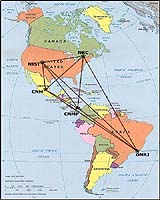
Washington DC (SPX) Jan 29, 2007 International time coordination is improving throughout the Americas thanks to a low-cost system relying on Global Positioning System (GPS) satellites and the Internet, which enables much faster time comparisons and gives small countries the opportunity to evaluate easily their measurements in relation to others and to world standards. The time and frequency network of the Sistema Interamericano de Metrologia (SIM), or Inter-American Metrology System, began operation in 2005. The system includes national metrology institutes in member nations of the Organization of American States (OAS). The SIM network currently compares time and frequency measurements made in Brazil, Canada, Mexico, Panama and the United States. Costa Rica and Columbia are expected join the network soon, and additional OAS members have expressed interest. As the U.S. civilian timekeeper, the National Institute of Standards and Technology (NIST) participates in the SIM network and also calibrates other members' equipment, which consists of a computer-based measurement system and a GPS receiver provided by OAS. Institutes simultaneously compare their time scales to clocks on the same GPS satellites, and then automatically compare their results over the Internet. Time differences can be viewed on the Web by all laboratories in the network, with updates every 10 minutes. "Canada, Mexico and the United States now have better time coordination than ever before," says Mike Lombardi, a NIST scientist who is a member of the SIM working group on time and frequency. The three countries' times remained within 50 nanoseconds of each other for an eight-month period in 2006, according to a recent status report.* Measurement precision is good enough to calibrate the best regional standards. Lombardi says the SIM network boosts the stature and capabilities of tiny metrology institutes, which cannot establish traceability to fundamental measurement units unless they make international comparisons. "Some SIM laboratories never have compared their standards to anybody before, so that's where the real beauty of the network will come into play," he says. "The larger laboratories also benefit because they now can see the measurement results in near real time, instead of waiting from two to seven weeks as they had in the past, using other reporting methods." Related Links National Institute of Standards and Technology (NIST) All about the technology of space and more GPS Applications, Technology and Suppliers Understanding Time and Space Satellite-based Internet technlogies  Physicists Develop Test for String Theory
 La Jolla CA (SPX) Jan 25, 2007
For decades, scientists have taken issue with "string theory"-a theory of the universe which contends that the fundamental forces and matter of nature can be reduced to tiny one-dimensional filaments called strings-because it does not make predictions that can be tested. But researchers at the University of California, San Diego, Carnegie Mellon University, and The University of Texas at Austin have now developed an important test for this controversial "theory of everything." |
|
|

| The content herein, unless otherwise known to be public domain, are Copyright 1995-2006 - SpaceDaily.AFP and UPI Wire Stories are copyright Agence France-Presse and United Press International. ESA PortalReports are copyright European Space Agency. All NASA sourced material is public domain. Additionalcopyrights may apply in whole or part to other bona fide parties. Advertising does not imply endorsement,agreement or approval of any opinions, statements or information provided by SpaceDaily on any Web page published or hosted by SpaceDaily. Privacy Statement |