|
 |
 |
 |
 |
 |
 |
 |
 |
 |

| . |  |
. |
Crack-Up Comet Emitting X-Rays
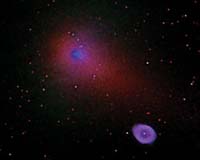
Greenbelt MD (SPX) May 14, 2006 NASA scientists said Friday they have detected X-rays from Comet 73P/Schwassman-Wachmann 3, which is now passing Earth and rapidly disintegrating on what could be its final orbit around the Sun. The scientists used an instrument aboard the Swift spacecraft to detect the X-ray emissions, which are the brightest ever observed from a comet. 73P/Schwassmann-Wachmann 3, visible with even a backyard telescope, is expected to achieve peak brightness this week, when it passes within 7.3 million miles of Earth, or about 30 times the distance to the Moon. Though the comet does not threaten an Earth impact, it will approach closely enough that astronomers should be able to determine not only its composition, but also the composition of the solar wind. Astronomers think solar particles are interacting with comet material to produce the X-rays. Scientists around the world are employing three orbiting X-ray observatories - NASA's Chandra, the European-led XMM-Newton, and the Japanese-led Suzaku � to observe the comet in the coming weeks. Swift has provided preliminary information on which the larger instruments can base their observations. "The Schwassmann-Wachmann comet is a comet like no other," said Scott Porter of NASA's Goddard Space Flight Center, part of the Swift observation team. "During its 1996 passage it broke apart. Now we are tracking about three dozen fragments. The X-rays being produced provide information never before revealed." Unlike the Deep Impact mission, which dispatched a penetrating probe into comet Tempel 1 last July 4, Schwassmann-Wachmann 3 broke apart naturally, and because it is much closer to Earth and the Sun, it currently appears about 20 times brighter in X-rays. "The Swift observations are amazing," said Greg Brown of Lawrence Livermore National Laboratory in California, who led the proposal for Swift observation time. "Because we are viewing the comet in X-rays, we can see many unique features. The combined results of data from several premier orbiting observatories will be spectacular." Swift is primarily a gamma-ray burst detector, but the satellite also carries X-ray and ultraviolet/optical telescopes. Because of its ability to reposition rapidly, Swift has been able to track the progress of the fast-moving Schwassmann-Wachmann 3. Swift is the first observatory to observe the comet in both ultraviolet light and X-rays simultaneously � something scientists consider crucial for testing theories about comets. From early spectroscopic examinations, Swift Swift has detected oxygen and hints of carbon, but the elements appear to be from the solar wind, not from the comet. Scientists think that X-rays are produced through a process called charge exchange, in which highly (and positively) charged particles from the Sun that lack electrons steal electrons from chemicals in the comet. Typical comet material includes water, methane and carbon dioxide. Charge exchange is analogous to the tiny spark seen in static electricity, only at a far greater energy. By comparing the ratio of X-ray energies emitted, scientists can determine the content of the solar wind and infer the content of the comet material. Swift, Chandra, XMM-Newton and Suzaku each provide complementary capabilities to determine this measurement. The combination of these observations will provide a time evolution of the X-ray emission of the comet as it passes. Porter and his colleagues at Goddard and Livermore tested the charge exchange theory in an earthbound laboratory in 2003. That experiment, at Livermore's EBIT-I electron beam ion trap, produced a complex spectrograph of intensity versus X-ray energy for a variety of expected elements in the solar wind and comet. "We are anxious to compare nature's laboratory to the one we created," Porter said. The German-led ROSAT mission, now decommissioned, was the first to detect X-rays from a comet, from Hyakutake in 1996. The discovery was considered a great surprise at the time, and it took about five years before scientists developed a suitable explanation. Now, 10 years after Hyakutake, the new observations could solve the mystery. Related Links Swift  Palomar Movie Tracks Crumbling Comet
 Palomar Mountain CA (SPX) May 14, 2006
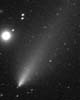
Astronomers tracking 73P/Schwassmann-Wachmann's passage through the nearby part of the solar system have collected enough images to create a movie of the comet's disassembly. |
|
|

| The content herein, unless otherwise known to be public domain, are Copyright 1995-2006 - SpaceDaily.AFP and UPI Wire Stories are copyright Agence France-Presse and United Press International. ESA PortalReports are copyright European Space Agency. All NASA sourced material is public domain. Additionalcopyrights may apply in whole or part to other bona fide parties. Advertising does not imply endorsement,agreement or approval of any opinions, statements or information provided by SpaceDaily on any Web page published or hosted by SpaceDaily. Privacy Statement |