|
 |
 |
 |
 |
 |
 |
 |
 |
 |

| . |  |
. |
Crunch Time For Mir As Time Runs Out For Safe Deorbit
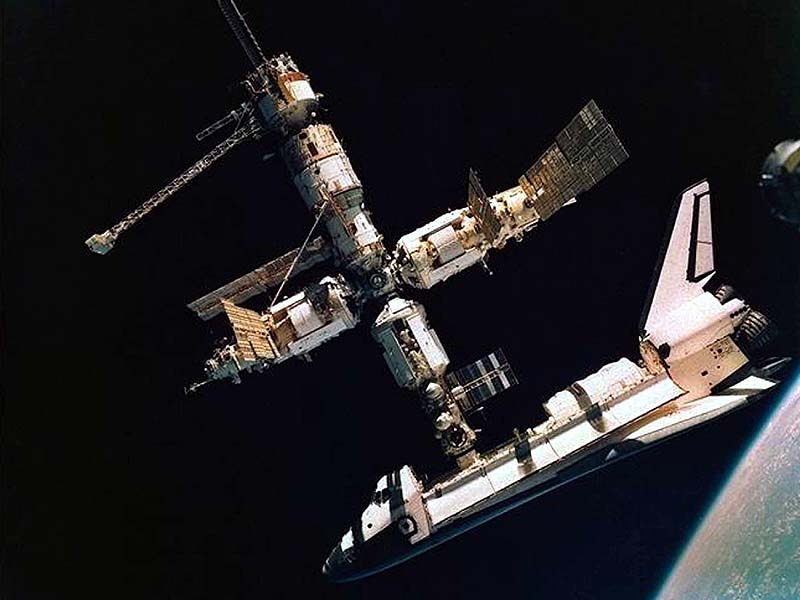
Moscow (AFP) March 19, 2001 Russia is set to fix the day and hour of the Mir space station's long-awaited splashdown into the Pacific Ocean on Tuesday amid concern that time is running out if the ageing orbiter is to be destroyed safely. "Space agency chiefs are due to hold a final meeting on this subject on Tuesday morning," said Sergei Gorbunov, spokesman for the Russian Space Agency. In the latest in a series of delays, the 15-year-old space station, once the pride of the Soviet space programme, is now expected to be ditched into the Pacific Ocean early on Friday, 24 hours later than announced last week. Originally planned for February 27-28, but postponed repeatedly because of technical breakdowns, the operation to bring Mir down to Earth has been put off course because the orbiter is descending at a slower speed than space experts calculated. But time is now of the essence, ground control warned, because Mir could drop to a critical altitude, re-entering the Earth's atmosphere unguided and with unpredictable consequences, if the Pacific splashdown is delayed until after March 26. "If the operation is not launched (before then), Mir will fall by itself," Russian mission control (TsUP) official Viktor Blagov told AFP. TsUP said Saturday it was now 80 percent certain that debris from the orbiter would splash down into the Pacific Ocean on Friday morning Moscow time at around 0600 GMT. The descent will be triggered when Mir reaches an altitude of 220 kilometres (130 miles) -- it was at 230 kilometres on Sunday -- when the Progress cargo ship's rocket engine will fire three short bursts. The first two are to correct Mir's orbit, and the third is to send it plunging into the ocean between New Zealand and Chile. Governments from across the world have expressed concern that the space station might miss its target, noting the long series of technical problems on board Mir in the past few months. In December, Russia's control centre lost contact with Mir for almost 24 hours, triggering widespread alarm at the possible security threat if such a communication breakdown recurred during the re-entry operation. Most of the station is expected to break up and burn as it hurtles through the Earth's atmosphere. But around 20 tonnes of the platform's 137-tonne mass are expected to survive the burn-up, with 1,500 pieces of debris, mostly very small but a few of them as large as a car, falling to Earth. Debris is expected to rain down on the South Pacific in a target area 200 kilometres (120 miles) wide, and 6,000 kilometres long, between New Zealand and Chile. The Russian space agency has taken out insurance for 200 million dollars to cover possible damage. In an unexpected twist to the Mir saga, it emerged Monday that Iran had offered, during a recent visit to Moscow by President Mohammad Khatami, to buy the doomed orbiter for military purposes, but the offer came too late. Iran had proposed paying for the maintenance of Mir for another two to three years in return for Russia's training Iranian cosmonauts, Radzhab Safarov of the state-funded Centre for Coordination of Russo-Iranian Projects told a press conference. "The Mir station, with the equipment onboard, could hardly fail to have a dual function, notably surveillance of missile launches and low-orbit flights, which would enable their interception," Safarov said. The pioneering Soviet-era space station, launched in 1986, is being brought to Earth since Russia has found that it is unable to finance its commitment both to Mir and to the 16-nation International Space Station. Related Links SpaceDaily Search SpaceDaily Subscribe To SpaceDaily Express  Mir to splash down March 22, early in morning
 Moscow - March 15, 2001
Russia announced Thursday the most precise timing yet for its destruction of the Mir space station, saying debris from the 15-year-old orbiter would splash down into the Pacific Ocean "around 0800 GMT" on March 22. |
|
|

|
|
|
|
|
|
|
|
|
|
|
|
| The content herein, unless otherwise known to be public domain, are Copyright 1995-2006 - SpaceDaily.AFP and UPI Wire Stories are copyright Agence France-Presse and United Press International. ESA PortalReports are copyright European Space Agency. All NASA sourced material is public domain. Additionalcopyrights may apply in whole or part to other bona fide parties. Advertising does not imply endorsement,agreement or approval of any opinions, statements or information provided by SpaceDaily on any Web page published or hosted by SpaceDaily. Privacy Statement |