|
 |
 |
 |
 |
 |
 |
 |

| . |  |
. |

|
|
. |

 by Dr. Tony Phillips for NASA Science News Hunstville AL (SPX) Jul 13, 2011
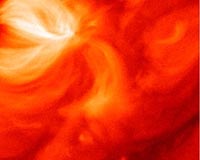
On June 7, 2011, Earth-orbiting satellites detected a flash of X-rays coming from the western edge of the solar disk. Registering only "M" (for medium) on the Richter scale of solar flares, the blast at first appeared to be a run-of-the-mill eruption--that is, until researchers looked at the movies. "We'd never seen anything like it," says Alex Young, a solar physicist at the Goddard Space Flight Center. "Half of the sun appeared to be blowing itself to bits." NASA has just released new high-resolution videos of the event recorded by the Solar Dynamics Observatory (SDO). The videos are large, typically 50 MB to 100 MB, but worth the wait to download. Click on the arrow to launch the first movie, then scroll down for commentary: "IN terms of raw power, this really was just a medium-sized eruption," says Young, "but it had a uniquely dramatic appearance caused by all the inky-dark material. We don't usually see that." Solar physicist Angelos Vourlidas of the Naval Research Lab in Washington DC calls it a case of "dark fireworks." "The blast was triggered by an unstable magnetic filament near the sun's surface," he explains. "That filament was loaded down with cool1 plasma, which exploded in a spray of dark blobs and streamers." The plasma blobs were as big as planets, many larger than Earth. They rose and fell ballistically, moving under the influence of the sun's gravity like balls tossed in the air, exploding "like bombs" when they hit the stellar surface. Some blobs, however, were more like guided missiles. "In the movies we can see material 'grabbed' by magnetic fields and funneled toward sunspot groups hundreds of thousands of kilometers away," notes Young. SDO also detected a shadowy shock wave issuing from the blast site. The 'solar tsunami' propagated more than halfway across the sun, visibly shaking filaments and loops of magnetism en route. [91 MB Quicktime] Long-range action has become a key theme of solar physics since SDO was launched in 2010. The observatory frequently sees explosions in one part of the sun affecting other parts. Sometimes one explosion will trigger another ... and another ... with a domino sequence of flares going off all around the star. "The June 7th blast didn't seem to trigger any big secondary explosions, but it was certainly felt far and wide," says Young. It's tempting to look at the movies and conclude that most of the exploded material fell back--but that wouldn't be true, according to Vourlidas. "The blast also propelled a significant coronal mass ejection (CME) out of the sun's atmosphere." He estimates that the cloud massed about 4.5 x10¹⁵ grams, placing it in the top 5% of all CMEs recorded in the Space Age. For comparison, the most massive CME ever recorded was 1016 grams, only a factor of ~2 greater than the June 7th cloud.2 The amount of material that fell back to the sun on June 7th was approximately equal to the amount that flew away, Vourlidas says. As remarkable as the June 7th eruption seems to be, Young says it might not be so rare. "In fact," he says, "it might be downright common." Before SDO, space-based observatories observed the sun with relatively slow cadences and/or limited fields of view. They could have easily missed the majesty of such an explosion, catching only a single off-center snapshot at the beginning or end of the blast to hint at what actually happened. If Young is right, more dark fireworks could be in the offing. Stay tuned.
|
. |
|
| The content herein, unless otherwise known to be public domain, are Copyright 1995-2011 - Space Media Network. AFP and UPI Wire Stories are copyright Agence France-Presse and United Press International. ESA Portal Reports are copyright European Space Agency. All NASA sourced material is public domain. Additional copyrights may apply in whole or part to other bona fide parties. Advertising does not imply endorsement,agreement or approval of any opinions, statements or information provided by Space Media Network on any Web page published or hosted by Space Media Network. Privacy Statement |

 del.icio.us
 Digg
Digg Reddit
 Google