|
 |
 |
 |
 |
 |
 |
 |
 |
 |

| . |  |
. |
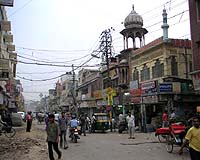
Delhi residents cough, wheeze as pollution soars
New Delhi (AFP) Jan 17, 2008 A stay in India's capital often leads to a case of the notorious "Delhi belly," but as pollution rises, many visitors and residents are suffering from the Delhi itchy eye and hacking cough too. Authorities blame the rise in pollution squarely on a jump in diesel cars, whose fumes are routinely cited in medical studies as a major health risk. About a third of the nearly 1,000 new cars that hit the city's roads every day are diesel models, which are becoming popular because the fuel is cheaper than petrol. But while there is a financial saving, it comes at a serious pollution and health cost, warn experts, who say New Delhi is rapidly losing the air quality gains made after switching its diesel bus fleet to compressed natural gas six years ago. Pollution figures show a steady rise in diesel-linked pollution during the past five years, a period that saw the total number of cars in Delhi leap 50 percent to 1.6 million. Anumita Roychoudhury, from New Delhi's Centre for Science and Environment, noted carbon monoxide levels were falling despite an increase in the number of petrol cars. However, "for diesel cars, the increase in vehicle numbers and increase in nitrogen dioxide are strongly correlated," she said. She pointed to "horrendously" high levels of lung-irritating soot linked to tailpipe diesel emissions, which environmentalists regard as one of the most toxic forms of air pollution. Roychoudhury urged India to adopt ultra-clean car standards cutting diesel sulphur levels. "You need a technology leapfrog," she told AFP. The planned launch of the world's smallest car, the Nano, by India's Tata Motors has further heightened concerns about increased congestion in the city even though it is only producing a petrol version. The makers of the car, mean to retail for 100,000 rupees (2,500 dollars), insist its emissions are as low or lower than any two-wheeler on Indian roads and meet European standards. That's only half the point, said Sunita Narain, who directs the Centre for Science and Environment, who got the Supreme Court to order the New Delhi bus system to shift to natural gas. "I am not fighting the small car," she added. "I am simply asking for many more buses and bus lanes -- a complete change in mobility. "The solution is not to ban the 100,000 rupee car," Narain urged, but "tax it like crazy until it (India) has a proper mass transit system." Doctors, too, say they have seen the worrying effects of the rise in diesel car numbers. Randeep Guleria, a chest specialist at the All-India Institute of Medical Sciences, the country's largest public hospital, said the high pollution level triggered asthma in people where the condition previously had been latent. "We are seeing a lot of such patients, who did not have any problems when they were outside and when they move to Delhi they suddenly develop symptoms," he said. One of Guleria's patients said her asthma symptoms improve during the six months she spends with a son in New Jersey, in the United States. But it is a different story when she comes back to the Indian capital. "It has been really bad since I came back in November. I cough all night," said Madhu Puri, 59. "If I go to America or a foreign city I feel better." A US environmental Protection Agency panel has called diesel fuel exhaust a "likely human carcinogen," linking it with lung cancer and asthma attacks. Some studies show children are among the worst-affected by the dense haze that often shrouds the city, and doctors frequently tell parents to keep their children indoors when smog levels are particularly high. Researchers believe particulates, or tiny particles of soot, interfere with the respiratory system because they are so small they can be breathed deeply into the lungs. In a survey of almost 12,000 city schoolchildren late last year, 17 percent reported coughing, wheezing or breathlessness, compared to just eight percent of children in a rural area. What researchers saw were the effects of "chronic exposure from living in Delhi," said Twisha Lahiri, of India's Chittaranjan National Cancer Institute, who led the study. Community Email This Article Comment On This Article Related Links Our Polluted World and Cleaning It Up
 Herons Persist In Chicago Wetlands Despite Exposure To Banned Chemicals
 Champaign IL (SPX) Jan 17, 2008
Herons nesting in the wetlands of southeast Chicago are still being exposed to chemicals banned in the U.S. in the 1970s, a research team reports. The chemicals do not appear to be affecting the birds' reproductive success, however. The findings appear in the current issue of the Journal of Great Lakes Research. |
|
|

| The content herein, unless otherwise known to be public domain, are Copyright 1995-2007 - SpaceDaily.AFP and UPI Wire Stories are copyright Agence France-Presse and United Press International. ESA Portal Reports are copyright European Space Agency. All NASA sourced material is public domain. Additional copyrights may apply in whole or part to other bona fide parties. Advertising does not imply endorsement,agreement or approval of any opinions, statements or information provided by SpaceDaily on any Web page published or hosted by SpaceDaily. Privacy Statement |