
 |
 |
 |
 |
 |
 |
 |
 |
 |
 |

| . |  |
. |

Paris, France (ESA) Sep 17, 2010 ESA's mission to measure the precise positions of a billion stars reached an important milestone on 3 September with the delivery of its first primary mirror. The second primary mirror is near completion and scheduled to arrive at the Toulouse test and integration centre of prime contractor EADS Astrium during October. Gaia will carry two identical telescopes, each fitted with four mirrors (M1 to 4). A further two mirrors (M5 and 6) will send the light from these dual instruments into the same focal plane. To date, six of the 10 rectangular mirrors have been delivered. They are: the M3A tertiary mirror, whose dimensions are 0.65 x 0.275 m; both of the M4 combiner mirrors (dimensions 0.19 x 0.07 m), and the M5 and M6 mirrors (dimensions 0.54 x 0.36 m), in addition to the M1A primary mirror (dimensions 1.49 x 0.54 m). All of the mirrors have been fabricated from blanks made of sintered silicon carbide (SiC), a relatively new material in mirror fabrication for space missions. The blanks were made by Boostec in France. Silicon carbide was selected because it allows each mirror to be extremely strong and rigid, but lightweight and with a high thermal conductivity - important not only for its on-orbit performance, but also for minimising deformations caused by Earth's gravity during ground testing. Each primary mirror is shaped by the French company Sagem (located close to Paris), using computer-guided milling and polishing machines, and weighs about 40 kg. To achieve sufficient smoothness, all of the mirror blanks were coated with a thin layer of silicon carbide by chemical vapour deposition before polishing started. This process was carried out by Schunk Kohlenstofftechnik in Heuchelheim, Germany. The polishing is a slow, painstaking process which requires each mirror to be polished to a precision of about 10 nanometres RMS. To appreciate this technical achievement one can consider that if the Gaia M1 mirror was scaled to the size of the Atlantic ocean, any bumps on the surface would be of the order of a few centimetres. The mirrors also have an unusual curved shape, which is calculated using a very precise mathematical formula so that there will be no distortion of the incoming light across the telescopes' field of view and at all wavelengths from blue to red. After polishing, the surface is coated with enhanced silver reflective coating. This coating involves the addition of a dielectric amplification layer, which protects the silver from tarnishing and enhances its reflectivity across the entire spectral range (320 - 1000 nanometres) to be studied by Gaia. "The mirrors are being integrated on the structural payload module in order to complete the optical train and enable testing to begin," said Matthias Erdmann, ESA's Gaia payload system engineer. "Their shape and size were determined by the room available within the payload fairing of the Soyuz-Fregat launcher." "The M1 mirrors have a collecting area about 11 times bigger than the primary mirror of its predecessor, ESA's Hipparcos astrometry spacecraft, enabling them to collect many more photons," said Jos de Bruijne, Deputy Project Scientist for Gaia. "The combination of size, smoothness and special shape is required to provide a wide angle of view - about 0.7 degrees - and a small wave front error that will give extremely sharp images of a billion stars in our Galaxy." Gaia will view two widely separated areas of the sky, using two identical telescopes. Over its five-year mission, it will scan the entire sky, observing each of its target stars about 70 times. By accurately monitoring the two-dimensional star positions on the sky, it will be possible to infer their lateral motions across the sky and to calculate their precise three-dimensional locations, even for objects as far away as the galactic centre. Gaia will also measure the spectra of the brightest 15% of those stars, mainly in order to determine their radial velocities. Launch of Gaia on a Soyuz-Fregat is currently scheduled for November 2012.
Share This Article With Planet Earth
Related Links ESA Gaia Space Telescope News and Technology at Skynightly.com

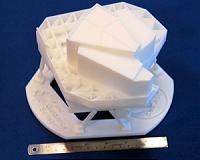 NASA Goddard Receives The Webb Telescope's Guiding Light From Canada
Greenbelt MD (SPX) Sep 09, 2010 The Canadian Space Agency has delivered a test unit of the Fine Guidance Sensor to the James Webb Space Telescope to NASA's Goddard Space Flight Center in Greenbelt, Md. The arrival of the engineering test unit marks a major milestone for the Canadian team. The hardware has been put through its paces at the Canadian Space Agency's David Florida Lab to ensure that the final version will f ... read more |
|
|
| The content herein, unless otherwise known to be public domain, are Copyright 1995-2010 - SpaceDaily. AFP and UPI Wire Stories are copyright Agence France-Presse and United Press International. ESA Portal Reports are copyright European Space Agency. All NASA sourced material is public domain. Additional copyrights may apply in whole or part to other bona fide parties. Advertising does not imply endorsement,agreement or approval of any opinions, statements or information provided by SpaceDaily on any Web page published or hosted by SpaceDaily. Privacy Statement |


 del.icio.us
 Digg
Digg Reddit
 YahooMyWeb
 Google
 Facebook


