|
 |
 |
 |
 |
 |
 |
 |
 |
 |

| . |  |
. |
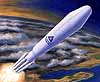
Delta 3 Successfully Places Data-Gathering Payload into Orbit
Cape Canaveral - August 23, 2000 - A data-gathering, simulated payload was successfully placed into orbit today aboard a Boeing Delta III rocket. The launch vehicle lifted off at 7:05 a.m. EDT. Instruments aboard the 9,480-pound satellite will provide information to further validate Boeing baseline data on launch vehicle performance. Engineers will begin tracking the payload for satellite studies by the U.S. Air Force and the University of Colorado. "Today, Delta III flew the same flight profile as the mission last year, allowing us to compare data from both flights on an event-by-event basis," said Gale Schluter, vice president-general manager of Boeing Expendable Launch Systems. "This success confirms our confidence in Delta III." Designated DM-F3 for Delta Mission-Flight 3, the payload was designed to match the mass and frequency characteristics of common commercial communication satellites sized for Delta III. Thus, the interaction during flight between an actual payload and the Delta III was accurately duplicated. Boeing modified the payload to assist U.S. Air Force engineers in the calibration and testing of electro-optical space imaging systems. Reflective surfaces on the simulated satellite also provide laser cross-section targets at both visible and infrared wavelengths. In addition, the DM-F3 payload will be used by the Air Force to verify its thermal standards and models for satellites. Verification of models used to predict payload dynamics will be accomplished by viewing the spin rate of the payload. In addition, the University of Colorado Center for Astrodynamics Research plans to analyze data to determine the affect of the orbital environment on the payload. Delta III was designed to address the growing size of commercial satellites and move Boeing out of its role as a niche player in the launch industry. The Delta III can carry to geosynchronous transfer orbit 8,800 pounds (3,800 kg), or twice the payload of the Delta II. A larger fairing to house bigger payloads and a new cryogenically propelled upper stage with a Pratt & Whitney-built single engine is used by Delta III. The vehicle uses existing components and infrastructure similar to that used with the Delta II launch. Delta III engineering, manufacturing and program management are led by Boeing Expendable Launch Systems based in Huntington Beach, Calif., with final assembly in Pueblo, Colo. The Delta launch team at Cape Canaveral Air Force Station handles launch coordination and operations. Boeing manufactures the Delta III main engine, the RS-27A, in Canoga Park, Calif. Major Delta III suppliers include: Alliant Techsystems, Inc., Magna, Utah, strap-on solid rocket motors; Pratt & Whitney, West Palm Beach, Fla., RL10B-2 cryogenic upper-stage engine; Mitsubishi Heavy Industries, Nagoya, Japan, 13-foot (4-meter) fuel tanks; and L3 communications, Teterboro, N.J., Redundant Inertial Flight Control Assembly avionics system.
 Globs in space
 Princeton - August 23, 2000 -
 Could bizarre giant particles nearly as big as galaxies, but lighter than electrons, dig cosmology out of a hole? Physicists suggest the universe is jam-packed with these strange particles, which might explain why small galaxies are far rarer in the universe than theory predicts. |
|
|

|
|
|
|
|
|
|
|
|
|
|
|
| The content herein, unless otherwise known to be public domain, are Copyright 1995-2006 - SpaceDaily.AFP and UPI Wire Stories are copyright Agence France-Presse and United Press International. ESA PortalReports are copyright European Space Agency. All NASA sourced material is public domain. Additionalcopyrights may apply in whole or part to other bona fide parties. Advertising does not imply endorsement,agreement or approval of any opinions, statements or information provided by SpaceDaily on any Web page published or hosted by SpaceDaily. Privacy Statement |