|
 |
 |
 |
 |
 |
 |
 |
 |
 |

| . |  |
. |
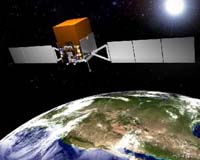
Delta II Rocket Coming Together For NASA's GLAST Satellite Launch
Greenbelt MD (SPX) Apr 15, 2008 The Delta II 7920-H, or "Heavy," rocket that will launch NASA's Gamma-ray Large Area Telescope (GLAST) satellite is in the process of being assembled on Launch Pad 17-B at Cape Canaveral Air Force Station, Fla. Solid rocket boosters were recently attached to the rocket. A series of nine strap-on solid rocket motors will next be mated with the rocket to help power the first stage. Because the Delta rocket is configured as a Delta II 7920 Heavy, the boosters are larger than those used on the standard configuration. "The Delta II is one of our most reliable launch vehicles," said Rick Harnden, GLAST Program Scientist at NASA Headquarters, Washington. "However, we'll be breathing a lot easier once GLAST has been lofted successfully into orbit." GLAST is slated for launch from the Cape Canaveral Air Station on May 16. The window for launch runs between 11:45 a.m. - 1:40 p.m. EDT. NASA's Launch Services Program office at the Kennedy Space Center (KSC) is responsible for the integration of GLAST with the Delta II. In addition, KSC is responsible for countdown management, and provides ground support necessary for final GLAST spacecraft preparations. The Delta II is provided to NASA as a launch service by the United Launch Alliance. GLAST is a powerful space observatory that will explore the most extreme environments in the Universe, where nature harnesses energies far beyond anything possible on Earth. It will search for signs of new laws of physics and what composes the mysterious dark matter, explain how black holes accelerate immense jets of material to nearly light speed, and help crack the mysteries of the stupendously powerful explosions known as gamma-ray bursts. The GLAST spacecraft is 9.2 feet high by 8.2 feet in diameter when stowed in the rocket, where it is just under the 9-foot diameter allowed in the fairing. GLAST becomes a little bit taller and much wider after it is launched into space, when the Ku-band antenna deploys and the solar arrays are extended. NASA's GLAST mission is an astrophysics and particle physics partnership, developed in collaboration with the U.S. Department of Energy, along with important contributions from academic institutions and partners in France, Germany, Italy, Japan, Sweden, and the United States. Community Email This Article Comment On This Article Related Links GLAST Space Telescope News and Technology at Skynightly.com
 Planck Spacecraft Fine Balancing in LSS
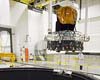 Noordwijk, Netherlands (ESA) Apr 15, 2008
On Wednesday the 2nd of April the Planck flight model spacecraft was placed inside the Large Space Simulator (LSS) at the ESTEC test facilities for fine balancing. After the arrival on 28 March at ESTEC, unpacking, and several spacecraft preparations in the cleanroom, the Planck spacecraft was hoisted up from its ground support equipment (GSE) and transferred to the LSS by means of the overhead crane. |
|
|

| The content herein, unless otherwise known to be public domain, are Copyright 1995-2007 - SpaceDaily.AFP and UPI Wire Stories are copyright Agence France-Presse and United Press International. ESA Portal Reports are copyright European Space Agency. All NASA sourced material is public domain. Additional copyrights may apply in whole or part to other bona fide parties. Advertising does not imply endorsement,agreement or approval of any opinions, statements or information provided by SpaceDaily on any Web page published or hosted by SpaceDaily. Privacy Statement |