|
 |
 |
 |
 |
 |
 |
 |
 |
 |

| . |  |
. |
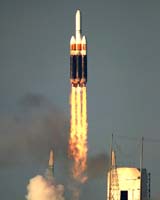
Delta IV Heavy Launch Failure Investigation Continues
Los Angeles AFB CA (SPX) Jan 25, 2005 The Boeing Company and the Air Force continue to make solid progress in their investigation into the premature Main Engine Cut-Off (MECO) on the Delta IV Heavy Lift Vehicle (HLV) demonstration mission that was launched Dec. 21, 2004. A Fault Tree analysis, which is used to categorize the potential root causes to include propulsion, avionics, and flight environments, etc., has begun. Forty of the forty-nine branches of the fault tree have been reviewed, ruled out as potential causes of the anomaly, and determined not to be a factor. These fault tree closures continue to clear the flight control systems�(flight software and engine cut-off (ECO) sensors), the RS-68 main engine and the basic structure. � The leading cause of the anomaly remains a cavitation-type disturbance of the liquid oxygen flow that caused the liquid oxygen to change to gaseous oxygen. This disruption of the smooth flow of liquid oxygen from the propellant tank to the engine is caused by a unique combination of vehicle acceleration,�liquid oxygen�level in the propellant tank,�tank pressures,�and flow rates in the feedline when the RS-68 engine is at full power. The engine cutoff sensors reacted to the cavitation, indicating a depletion of liquid oxygen propellant. In reality, there was adequate propellant in the tank to support the expected duration of the RS-68 engine burns. � Based upon progress to date, the combined Air Force and Boeing investigation team aims to complete the�fault tree�closeout and identify the cause by mid-February. Additional testing to support computer simulations that analyze the liquid oxygen flow between the bottom of the propellant tank and the engine cutoff sensors through the feedline could continue through March. Corrective actions will not be decided upon until the investigation identifies the cause. "We're making great progress in working through our fault tree," said Dan Collins, vice president of Boeing Expendable Launch Systems. "Our Air Force and Boeing investigation team remains confident that we will identify the cause of the early MECO in a timely manner and determine an appropriate solution prior to our next scheduled Delta IV launch later this year." A post-flight review of the complete HLV demonstration mission through payload separation is scheduled for late January. This formal review will evaluate all aspects of the mission to include achievement of the following significant test objectives: - Activating and launching from the heavy version of the Delta IV launch pad - Flying three common booster cores - Separating the two strap-on common booster cores from the center booster core - Flying the first 5-meter diameter composite payload fairing and separating it from the vehicle - Flying the first 5-meter diameter cryogenic upper stage through a long duration, 3-burn profile of the RL10B-2 engine "The investigation team is making solid progress in identifying the cause of the early engine shutdowns. The investment the Delta IV team made in additional telemetry has helped support the engineers as they narrow in on the cause of anomaly. I remain confident we will then be able to find solutions that allow us to avoid this problem on future flights," said Col John Insprucker, Evolved Expendable Launch Vehicle Program Director, Space and Missile Systems Center, and the Air Force mission director for the demonstration launch. Related Links Space & Missile Systems Center Boeing SpaceDaily Search SpaceDaily Subscribe To SpaceDaily Express  RocketCar To Use SpaceDev Motors
 Perth, Australia (SPX) Jan 05, 2005
Rosco McGlashan, the "Fastest Aussie on Earth" will attempt to become the fastest man in the world by exceeding 900 mph in his new rocket powered Aussie Invader race car. McGlashan announced that he is engaged in ongoing design discussions for the world's fastest car with rocket motor developer SpaceDev of Poway, California, and with car designer John "Ackers" Ackroyd of the Isle of Wight. |
|
|

| The content herein, unless otherwise known to be public domain, are Copyright 1995-2006 - SpaceDaily.AFP and UPI Wire Stories are copyright Agence France-Presse and United Press International. ESA PortalReports are copyright European Space Agency. All NASA sourced material is public domain. Additionalcopyrights may apply in whole or part to other bona fide parties. Advertising does not imply endorsement,agreement or approval of any opinions, statements or information provided by SpaceDaily on any Web page published or hosted by SpaceDaily. Privacy Statement |