|
 |
 |
 |
 |
 |
 |
 |
 |
 |

| . |  |
. |
Details Of Solar Particles Penetrating The Earth Environment Revealed
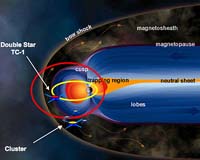
Paris, France (ESA) Oct 04, 2006 Co-ordinated efforts by China/ESA's Double Star and ESA's Cluster spacecraft have allowed scientists to zero in on an area where energetic particles from the Sun are blasting their way through the Earth's magnetic shield. Solar material penetrating the Earth's magnetic shield can represent a hazard to both astronauts and satellites. On 8 May 2004, one of the two Double Star satellites (TC-1) and all four Cluster spacecraft found themselves in the firing line. For about 6 hours, the Cluster spacecraft were buffeted every 8 minutes by intense flows of electrically charged particles released by the Sun. The Double Star TC-1 spacecraft had it even rougher, being blasted every four minutes for eight hours. During such events, magnetic channels created by the merging of the Sun and the Earth's magnetic fields allow solar particles to break through the Earth's magnetic shield and penetrate the Earth's environment. Physicists call the occurrence of these magnetic channels Flux Transfer Events. Each magnetic channel appears like a curve shaped tube that can be anything from 5000 to 25000 kilometres in diameter. One end of the magnetic flux tube is connected to Earth while the other end is connected to the solar wind. The basic physical mechanism responsible for the occurrence of flux transfer events is called magnetic reconnection. In the 1950s, space physicists believed that magnetic reconnection let solar particles break through at a steady rate. That view changed in the late 1970s, when several studies showed that the magnetic reconnection could also be intermittent and take place in pulses, lasting a few minutes. Each pulse produces a magnetic flux tube (a Flux Transfer Event). On 8 May 2004, these magnetic flux tubes swept over Cluster and Double Star again and again. As the Cluster and Double Star data clearly showed, the same location underwent magnetic reconnection several times, creating new successive magnetic flux tubes to channel more charged particles towards the Earth. The observations stopped probably because the spacecraft moved out of range and not because the reconnection region weakened in any way. The data from the five spacecraft allowed scientists led by Aur�lie Marchaudon of the Laboratoire de Physique et Chimie de l'Environnement, Centre Nationale de la Recherche Scientifique (CNRS) and Universit� d'Orl�ans, Orl�ans, France to triangulate the location of the magnetic reconnection region, and to deduce its size. They found that the reconnection site was located on the daylight west side of the Earth's magnetic shield and was around 25000 kilometres across. A computer simulation of the event, conducted by Jean Berchem of the University of California Los Angeles (UCLA) and his team, confirmed the possibility of magnetic reconnection occurring at that location. Although intermittent reconnection has been observed in the past, this was one of the longest series of continuous observations ever taken of a magnetic reconnection region in the Earth's magnetosphere. Perhaps most surprising is that 8 May 2004 was just relatively a normal day for the Earth's magnetic field. There were no large magnetic storms on Earth, or spectacular aurorae to fill the night sky. However, Cluster and Double Star revealed that energetic particles from the Sun were blasting their way through the Earth's magnetic shield and penetrating the Earth's environment. Each day, Cluster and Double Star return more observations that allow scientist to understand the invisible magnetic turbulence high above our heads. Related Links ESA's Space Weather pages Solar Science News at SpaceDaily  Instruments Enhance Space Weather Forecasts
 Kirtland AFB NM (AFPN) Sep 28, 2006
Improving the prediction of ionospheric-created disturbances is the aim behind two weeks of digging through 3 feet of snow, ice and slush in the tundra of Greenland by four members of the Air Force Research Laboratory Space Vehicles Directorate, with assistance from Danish personnel. |
|
|

| The content herein, unless otherwise known to be public domain, are Copyright 1995-2006 - SpaceDaily.AFP and UPI Wire Stories are copyright Agence France-Presse and United Press International. ESA PortalReports are copyright European Space Agency. All NASA sourced material is public domain. Additionalcopyrights may apply in whole or part to other bona fide parties. Advertising does not imply endorsement,agreement or approval of any opinions, statements or information provided by SpaceDaily on any Web page published or hosted by SpaceDaily. Privacy Statement |