
 |
 |
 |
 |
 |
 |
 |
 |
 |
 |

| . |  |
. |

Rochester NY (SPX) Jul 23, 2010 The hunt is on for Earth-like planets outside of our solar system. Since the 1990s, astronomers have detected more than 450 extrasolar planets - mostly large Jupiter-sized bodies - around nearby stars. Advances in technology are fueling the quest to find smaller, rocky planets resembling Earth and, possibly, evidence of life. Rochester Institute of Technology scientist Don Figer is developing detector technology funded by NASA's Technology Development for Exoplanet Missions Program and designed to directly image and characterize exoplanets. The two-year funded project will result in a detector array that can withstand the radiation in space, count individual photons or light pulses - thereby eliminating noise that could obscure the faint signal - and characterize exoplanets in one-third the time it takes using existing methods. "If you can detect something much more quickly you can search many more systems," says Figer, director of the Rochester Imaging Detector Laboratory and professor in the College of Science at RIT. "A three-year mission becomes a one-year mission, or you can detect three times as many objects in the same fixed time. That's usually what astronomers like to do." To accomplish this "super" detector, Figer and his colleagues at Massachusetts Institute of Technology Lincoln Laboratory are adapting technology they are currently developing for ground-based applications, such as the Thirty Meter Telescope. That project, funded by the Moore Foundation, supports the development of optical and infrared megapixel zero-read-noise detectors. Both initiatives build on detector technology originally invented at Lincoln Laboratory. The primary work at RIT for the NASA Technology Development for Exoplanet Missions Program will focus on radiation testing. Figer's team is building the system to gauge the detector's performance in the high-energy radiation environment of space. Scientists at Lincoln Laboratory are fabricating the 256 by 256 pixel array. Each pixel will be 25 by 25 microns; each detector will span 1/4 by 1/4 inch. "The goal in an exoplanet search depends on the question one wants to answer," Figer says. "If you want to characterize planetary systems around other stars then you probably need to detect the full mass spectrum of exoplanets. Right now, they're only discovering the big ones. If you think the real goal is to detect life, you might want to find smaller planets more like the size of the Earth." Since the 1990s, large, gaseous exoplanets have been discovered using the Doppler shift method. Scientists using this approach measure the changing line-of-sight velocity of a nearby star and infer the planet's characteristics from the amplitude and frequency of those variations. In contrast, the coronagraphic technique images an exoplanet by blocking the starlight. Occultation, another method in exoplanet research, uses the planet itself to block light from the star, extracting information from the attenuation of light during the eclipse. "One of the potentially most dramatic applications of zero-read noise technology might be in the occultation application because you're required to make quick measurements at very fine time intervals," Figer says. "But when you make quick measurements with detectors the noise is higher. For a detector that doesn't have read noise but detects individual photons, the noise would be zero regardless of how fast it is reading out." "I think, if it's successful, it will pervade many applications in many fields," Figer adds. "In particular, for space astrophysics it would become a new standard."
Share This Article With Planet Earth
Related Links Rochester Institute of Technology Lands Beyond Beyond - extra solar planets - news and science Life Beyond Earth

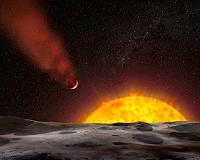 NASA Finds Super-Hot Planet With Unique Comet-Like Tail
Boston MA (SPX) Jul 16, 2010 Astronomers using NASA's Hubble Space Telescope have confirmed the existence of a baked object that could be called a "cometary planet." The gas giant planet, named HD 209458b, is orbiting so close to its star that its heated atmosphere is escaping into space. Observations taken with Hubble's Cosmic Origins Spectrograph (COS) suggest powerful stellar winds are sweeping the cast-off atmosph ... read more |
|
|
| The content herein, unless otherwise known to be public domain, are Copyright 1995-2010 - SpaceDaily. AFP and UPI Wire Stories are copyright Agence France-Presse and United Press International. ESA Portal Reports are copyright European Space Agency. All NASA sourced material is public domain. Additional copyrights may apply in whole or part to other bona fide parties. Advertising does not imply endorsement,agreement or approval of any opinions, statements or information provided by SpaceDaily on any Web page published or hosted by SpaceDaily. Privacy Statement |


 del.icio.us
 Digg
Digg Reddit
 YahooMyWeb
 Google
 Facebook


