|
 |
 |
 |
 |
 |
 |
 |
 |
 |

| . |  |
. |
DigitalGlobe Announces Launch Date For WorldView-1
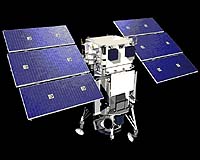
Boulder CO (SPX) Aug 15, 2007 Ball Aerospace and Technologies, ITT Corporation and DigitalGlobe, the provider of the world's highest-resolution imagery and geospatial information products, today announced delivery of its WorldView-1 satellite to Vandenberg Air Force Base in California for its scheduled launch on Tuesday, September 18, 2007. WorldView-1 is the first of two new next-generation satellites DigitalGlobe plans to launch. Upon launch on September 18, WorldView-1 will undergo a calibration and check out period and will deliver imagery soon after. First imagery from WorldView-1 is expected to be available prior to October 18, the sixth anniversary of the launch of QuickBird, DigitalGlobe's current satellite. WorldView-1 will have an average revisit time of 1.7 days and will be capable of collecting up to 750,000 square kilometers (290,000 square miles) per day of half-meter imagery. The satellite will also be equipped with state-of-the- art geo-location accuracy capabilities and will exhibit stunning agility with rapid targeting and efficient in-track stereo collection. "This is a momentous milestone that brings us one step closer to the launch of our next-generation satellite system," said Jill Smith, CEO of DigitalGlobe. "The addition of WorldView-1 and WorldView-2 in the coming months will bring the total number of satellites DigitalGlobe has in orbit to three, completing a constellation of spacecraft that will offer the highest collection capacity, more than 1 million square kilometers per day." WorldView-1 is part of the National Geospatial-Intelligence Agency (NGA)'s NextView program. The NextView program is designed to ensure that the NGA has access to commercial imagery in support of its mission to provide timely, relevant and accurate geospatial intelligence in support of national security. The majority of the imagery captured by WorldView-1 for the NGA will also be available for sale through DigitalGlobe's archive. Additionally, the launch of WorldView-1 immediately frees up capacity on DigitalGlobe's QuickBird satellite to meet the growing commercial demand for multi-spectral geospatial imagery. "Ball Aerospace and DigitalGlobe have worked side-by-side on commercial remote sensing satellites for more than a decade to create one of the most capable systems in orbit," said David L. Taylor, president and CEO of Ball Aerospace. "The next-generation WorldView-1 and WorldView-2 satellites will capture more imagery than ever before due to the flexibility afforded by the Control Moment Gyro-based system designed by Ball Aerospace." "Not only will ITT's digital imaging sensor for WorldView-1 boast half-meter resolution with three-meter geo-location, it'll do so using less space, weight and power than any previously launched system," said Frank Koester, vice president and director, Commercial and Space Sciences Programs, ITT Space Systems Division, based in Rochester, New York. "ITT looks forward to the successful test and launch of WorldView-1, followed by further success providing the sensor system for DigitalGlobe's WorldView-2." Community Email This Article Comment On This Article Related Links DigitalGlobe Ball Aerospace and Technologies ITT Corporation Earth Observation News - Suppiliers, Technology and Application
 Radar reveals vast medieval Cambodian city: study
 Chicago (AFP) Aug 13, 2007
Archaeologists using radar imagery have shown that an ancient Cambodian settlement centered on the celebrated temple of Angkor Wat was far more extensive than previously thought, a study released Monday said. |
|
|

| The content herein, unless otherwise known to be public domain, are Copyright 1995-2006 - SpaceDaily.AFP and UPI Wire Stories are copyright Agence France-Presse and United Press International. ESA PortalReports are copyright European Space Agency. All NASA sourced material is public domain. Additionalcopyrights may apply in whole or part to other bona fide parties. Advertising does not imply endorsement,agreement or approval of any opinions, statements or information provided by SpaceDaily on any Web page published or hosted by SpaceDaily. Privacy Statement |