
 |
 |
 |
 |
 |
 |
 |
 |
 |
 |

| . |  |
. |

Barcelona, Spain (SPX) Jan 19, 2011 Recently published in an article of the Astronomy and Astrophysics journal, a group of researchers from the Institute of Space Sciences (IEEC-CSIC) at Universitat Autonoma de Barcelona has discovered, for the first time, a delta Scuti pulsating star that hosts a hot giant transiting planet. The study was carried out by the PhD student, Enrique Herrero, the researcher Dr. Juan Carlos Morales, the exoplanet expert, Dr. Ignasi Ribas, and the amateur astronomer, Mr. Ramon Naves. WASP-33 (also known as HD15082) is hotter, more massive than the Sun (1.5 Msun) and is located at a distance of 378 light years away, in the constellation of Andromeda. It has the peculiarity of being a star that pulsates radially, like a balloon that inflates and deflates continuously, and non-radially, like the tides in Earth's oceans caused by the presence of the moon, which deforms the bodies of water between the poles and the equator. This star hosts a giant planet, WASP-33b, that was detected in 2006 through the transiting method. The planet's mass is four times the mass of Jupiter and it orbits the star at such a high speed that it only takes 1.2 days to complete its orbit. This very short orbital period indicates its extreme proximity to the star, 0.02 astronomical units (AU) when Mercury, the closest planet to the Sun, is at 0.39 AU. This planet is quite particular because it has a retrograde orbit and, evenmore, its orbit is quite inclined in angle respect to the star's equator. The study also suggests that the star's pulsations could be caused by the presence of the giant planet, something never seen before in any other planetary system. A small periodic signal, visible in the overall signal during the transit of the planet, called the attention of the researchers and through a thorough study, the pulsating modes of the star were determined and their possible relationship with the planet. Apart from being a pioneering study in the field, it is noteworthy to mention that the observations have been obtained from professional and amateur observatories. For the first time in its recent activity history, the Montsec Astronomical Observatory (OAdM) has provided most of the observations used for this research. In addition, the amateur astronomer R. Naves, from the Montcabrer Observatory, has provided excellent data, revealing the great importance of Professional-Amateur collaborations in this field. Therefore, the WASP-33 system represents a landmark in the world of exoplanets since it may provide vital information on pulsations modes that occur in stars, the effects of tides between stars and planets and the dynamical evolution of planetary systems.
Share This Article With Planet Earth
Related Links Universitat Autonoma de Barcelona Stellar Chemistry, The Universe And All Within It

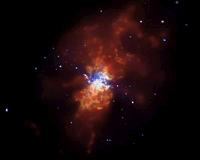 Chandra Images Torrent Of Star Formation
Boston MA (SPX) Jan 17, 2011 A new Chandra X-ray Observatory image of Messier 82, or M82, shows the result of star formation on overdrive. M82 is located about 12 million light-years from Earth and is the nearest place to us where the conditions are similar to those when the Universe was much younger with lots of stars forming. M82 is a so-called starburst galaxy, where stars are forming at rates that are tens or even ... read more |
|
|
| The content herein, unless otherwise known to be public domain, are Copyright 1995-2010 - SpaceDaily. AFP and UPI Wire Stories are copyright Agence France-Presse and United Press International. ESA Portal Reports are copyright European Space Agency. All NASA sourced material is public domain. Additional copyrights may apply in whole or part to other bona fide parties. Advertising does not imply endorsement,agreement or approval of any opinions, statements or information provided by SpaceDaily on any Web page published or hosted by SpaceDaily. Privacy Statement |


 del.icio.us
 Digg
Digg Reddit
 YahooMyWeb
 Google
 Facebook


