|
 |
 |
 |
 |
 |
 |
 |
 |
 |

| . |  |
. |
Drilling Into The Future
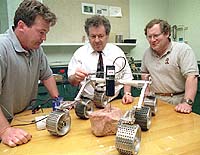
London - Jan. 10, 2001 Imagine a drill that penetrates granite using only the power of a flashlight battery. Then imagine sending that energy-efficient drill to another planet to explore beneath the surface. Or, perhaps, visualize putting the lightweight, sensitive instrument to work on Earth to improve medical care. Such a drill, recently developed at JPL and Cybersonics, Inc., has that power and potential. The Ultrasonic/sonic driller/corer demonstration unit weighs roughly .7 kilograms (1.5 pounds) and is able to drill 12-millimeter (half-inch) holes into hard rocks. Attached to the robotic arm of a future lander or on board a small rover, the drill could extract samples from the surface of an asteroid or planet surface during space missions. On Earth, potential medical uses include extracting pacemaker leads, assisting surgeries or facilitating diagnostic procedures that involve drilling into bone. The drill relies on a novel mechanism that produces high frequency vibrations and converts them to a hammering action at low frequency. The high frequency vibrations are generated by a stack of piezoelectric wafers, which can be powered by a battery. The drill consists of only three moving parts and it does not require gears, motors or lubricants. The drill requires very little pressure and it operates efficiently, drilling both soft and very hard rock, and it does not need sharpening. It extracts the produced debris by transporting them up the drilling shaft. The instrument is ideal for the exploration of other planets in space since it can operate in a wide range of temperatures as well as a vacuum. A more advanced drill model, called the ultrasonic gofer, is currently being developed to reach depths of several meters, or yards. This deep drill will be equipped with sensors that will make it even more effective for detecting samples. These sensors will also analyze samples in-situ, meaning in its location on a planet. Such a device could also be used on Earth to detect buried objects and for geophysical studies. Related Links JPL's NDEAA Ultrasonic Drilling Homepage Cybersonics SpaceDaily Search SpaceDaily Subscribe To SpaceDaily Express  U.S. Air Force Powers NASA's Land-Imaging Satellite
 Kirtland AFB - Jan 10, 2001
Launched November 21 from Vandenberg AFB, Calif., aboard the first in a series of NASA Earth Observing (EO) satellites was the Air Force Research Laboratory's (AFRL) Lightweight Flexible Solar Array (LFSA). |
|
|

|
|
|
|
|
|
|
|
|
|
|
|
| The content herein, unless otherwise known to be public domain, are Copyright 1995-2006 - SpaceDaily.AFP and UPI Wire Stories are copyright Agence France-Presse and United Press International. ESA PortalReports are copyright European Space Agency. All NASA sourced material is public domain. Additionalcopyrights may apply in whole or part to other bona fide parties. Advertising does not imply endorsement,agreement or approval of any opinions, statements or information provided by SpaceDaily on any Web page published or hosted by SpaceDaily. Privacy Statement |