
. Military Space News .
SPACEMART
ESA Astronaut will test CIMON aboard the ISS Watson AI
by Staff Writers
Bremen, Germany (SPX) Mar 06, 2018

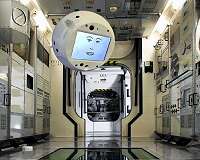
CIMON (Crew Interactive Mobile CompanioN) is a mobile and autonomous assistance system designed to aid astronauts with their everyday tasks on the ISS. This will be the first form of Artificial Intelligence (AI) on an ISS mission. CIMON is an experiment overseen by Space Administration at the German Aerospace Center (DLR) in cooperation with Airbus (Friedrichshafen/Bremen, Germany) as the prime contractor. CIMON is a free flyer fueled with Artificial Intelligence, enhancing human expertise. AI-based technology is about constantly understanding, reasoning and learning, so CIMON is designed to assist and to create a feeling of talking to a crew mate.

Airbus, in cooperation with IBM, is developing CIMON (Crew Interactive MObile CompanioN), an AI-based assistant for astronauts for the DLR Space Administration. The technology demonstrator, which is the size of a medicine ball and weighs around 5 kg, will be tested on the ISS by Alexander Gerst during the European Space Agency's Horizons mission between June and October 2018.

"In short, CIMON will be the first AI-based mission and flight assistance system," said Manfred Jaumann, Head of Microgravity Payloads from Airbus.

"We are the first company in Europe to carry a free flyer, a kind of flying brain, to the ISS and to develop artificial intelligence for the crew on board the space station." Pioneering work was also being done in the area of manufacturing, Jaumann continued, with the entire structure of CIMON, which is made up of plastic and metal, created using 3D printing.

CIMON is designed to support astronauts in performing routine work, for example by displaying procedures or - thanks to its 'neural' AI network and its ability to learn - offering solutions to problems. It uses Watson AI technology from the IBM cloud and, with its face, voice and artificial intelligence, becomes a genuine 'colleague' on board.

With CIMON, crew members can do more than just work through a schematic view of prescribed checklists and procedures; they can also engage with their assistant. In this way, CIMON makes work easier for the astronauts when carrying out every day routine tasks, helps to increase efficiency, facilitates mission success and improves security, as it can also serve as an early warning system for technical problems.

Airbus initially examined the concept for the assistance system as part of a self-financed study. Then, in August 2016, the Bonn-based DLR Space Administration commissioned Airbus' aerospace experts to carry out the project.

Since then, a 50-strong project team comprising members from Airbus, DLR, IBM and the Ludwig-Maximilians-Universitat Munich (LMU) has been working to ensure that CIMON takes shape and is brought to life: the system is learning to orientate itself and move around, it accumulates knowledge with the help of Watson AI technology and is training to recognise its human partners.

Amongst other things, the Watson AI was trained using voice samples and photos of Alexander Gerst, and procedures and plans of the Columbus module of the International Space Station were loaded into the database. Alexander Gerst also had a say in the selection of CIMON's screen face and computer voice so that he, too, could 'make friends' with his electronic colleague.

Once the functional testing of the system has been completed, Gerst will work in Space with CIMON a total of three times: They will experiment with crystals, work together to solve the Rubik's cube and perform a complex medical experiment using CIMON as an 'intelligent' flying camera.

In its first Space mission, CIMON will only be equipped with a selected range of capabilities. In the medium term, aerospace researchers also plan to use the CIMON project to examine group effects that can develop over a long period of time in small teams and that may arise during long-term missions to the Moon or Mars.

Social interaction between people and machines, between astronauts and assistance systems equipped with emotional intelligence, could play an important role in the success of long-term missions. Airbus' developers are convinced that, here on Earth, developments of the assistance system could also find future use in hospitals and social care.

CIMON will get its first 'taste of space' as early as March 2018: the 31st DLR parabolic flight campaign will focus in particular on testing and optimising GNC algorithms (Guidance, Navigation and Control) under zero G conditions.


Related Links
ISS at ESA
The latest information about the Commercial Satellite Industry


Thanks for being here;
We need your help. The Space Media Network continues to grow but revenues have never been harder to maintain.

With the rise of Ad Blockers, and Facebook - our traditional revenue sources via quality network advertising continues to decline. And unlike so many other news sites, we don't have a paywall - with those annoying usernames and passwords.

Our news coverage takes time and effort to publish 365 days a year.

If you find our news sites informative and useful then please consider becoming a regular supporter or for now make a one off contribution.
SpaceMediaNetwork Contributor
$5 Billed Once


credit card or paypal
SpaceMediaNetwork Monthly Supporter
$5 Billed Monthly


paypal only


SPACEMART
ESA incubators ranked among world's best
Paris (ESA) Mar 03, 2018
Two of ESA BIC Sweden's incubators have been ranked fourth and seventh in the world classification of university affiliated business incubators among 259 evaluated in 53 countries. "Being top rated in the world shows that we here in the North are at the forefront and it's feels great," said Jens Lundstrom, CEO for Arctic Business Incubator (ABI) and Manager of ESA Business Incubator Centre (ESA BIC) Sweden. Among the top-winners announced at the World Incubation summit 2018 in Toronto, Canad ... read more

Comment using your Disqus, Facebook, Google or Twitter login.


Share this article via these popular social media networks
del.icio.usdel.icio.us DiggDigg RedditReddit GoogleGoogle

SPACEMART
Will missile defense be feeble against hypersonic weapons

America's missile-defense system not ready for hypersonic threats

U.S., Israel test Arrow 3 missile system

Israel, US Successfully Test Hetz 3 Exoatmospheric Anti-Missile System

SPACEMART
Javelin missile sale to Ukraine approved by State Department

After Russian veto, US and allies condemn Iran over missiles to Yemen

Raytheon, Lockheed to sell Javelins to multiple foreign customers

State Department approves potential $3.2B missile sale to Sweden

SPACEMART
Cameroon startup launches drones for global market

Russian military developing long-range supersonic missile-lobbing drone

Lightweight hyperspectral imagers bring sophisticated imaging capability to drones

TEOCO launches UAV Service Enablement Platform for Drones

SPACEMART
Airbus to provide near real-time access to its satellite data

Increasing Situational Awareness with Fortion TacticalC2

British astronaut hails 'groundbreaking' Airbus satellite

Northrop Grumman gets production, support contracts for E-2D Hawkeye

SPACEMART
Putin signs new State Arms Program focused on cutting-edge weaponry

Army taps Olin Corp. for $51.1M in small arms ammunition

Raytheon wins $77.3M Air Force contract for SDB II munitions

Army awards AM General $11.8M for 60 Humvees

SPACEMART
BAE profits fall, counts on government defence spend

Russia's Kalashnikov becomes majority private-owned

Airbus to pay 81 mn euros to end German corruption probe

US budget outline calls for huge Pentagon increase, cuts to State

SPACEMART
Putin's speech was to send a clear message to the US

US carrier on historic Vietnam visit amid sea rift with China

Trump praises China's Xi for lifetime mandate extension

Chinese grumble about 'emperor' as congress fetes Xi

SPACEMART
Nanomaterials: What are the environmental and health risks?

UT Dallas team's microscopic solution may save researchers big time

Researchers invent light-emitting nanoantennas

Nanomushroom sensors: One material, many applications


The content herein, unless otherwise known to be public domain, are Copyright 1995-2024 - Space Media Network. All websites are published in Australia and are solely subject to Australian law and governed by Fair Use principals for news reporting and research purposes. AFP, UPI and IANS news wire stories are copyright Agence France-Presse, United Press International and Indo-Asia News Service. ESA news reports are copyright European Space Agency. All NASA sourced material is public domain. Additional copyrights may apply in whole or part to other bona fide parties. All articles labeled "by Staff Writers" include reports supplied to Space Media Network by industry news wires, PR agencies, corporate press officers and the like. Such articles are individually curated and edited by Space Media Network staff on the basis of the report's information value to our industry and professional readership. Advertising does not imply endorsement, agreement or approval of any opinions, statements or information provided by Space Media Network on any Web page published or hosted by Space Media Network. General Data Protection Regulation (GDPR) Statement Our advertisers use various cookies and the like to deliver the best ad banner available at one time. All network advertising suppliers have GDPR policies (Legitimate Interest) that conform with EU regulations for data collection. By using our websites you consent to cookie based advertising. If you do not agree with this then you must stop using the websites from May 25, 2018. Privacy Statement. Additional information can be found here at About Us.