|
 |
 |
 |
 |
 |
 |
 |
 |
 |

| . |  |
. |
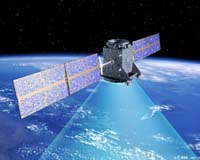
ESA Award SSTL Contract To Build A Second GIOVE-A
Paris, France (ESA) Mar 07, 2007 The European Space Agency (ESA) awarded a contract to Surrey Satellite Technology (SSTL) to build a second satellite for the Galileo satellite navigation system. Named GIOVE-A2, the new satellite will be based on the company's proven GIOVE-A medium Earth orbit satellite technology. GIOVE-A2 will help maintain the critical International Telecommunications Union (ITU) frequency filing secured by its predecessor for a further 27 months and facilitate further development of ground equipment. SSTL's Executive Chairman, Sir Martin Sweeting, commented, "With GIOVE-A, SSTL was able to provide ESA with a vital part of the Galileo system exactly when it was needed. GIOVE-A has performed well in orbit and we are very pleased to be working with ESA again on a second GIOVE satellite". Environmental monitoring is also an important ongoing mission objective for the new satellite. GIOVE-A was the first European satellite to be launched into medium Earth orbit (MEO) and it carries two environmental monitors. These units have been operated almost continuously since launch and are gathering vital data to characterise the Galileo orbit environment that will help in the design of the full constellation. The new satellite will carry some enhancements over GIOVE-A that will allow additional signals to be generated and received on the ground. The aim will be to provide early in-orbit experimentation on the common baseline L1 open service signals recently recommended by the EU and US. In the future, these open service signals will provide free of charge position and timing competitive with other GNSS systems to users. GIOVE-A was designed to broadcast Galileo signals from space so that Europe could claim the frequencies filed for Galileo with the ITU. Following a rapid development programme that started in the second half of 2003, the satellite was designed, built, tested and launched before the end of 2005. At 17:25 GMT on the 12th January 2006, the first Galileo signals were transmitted from the satellite. In March, ESA was able to confirm that it had brought the Galileo-related frequency filings into use, three months ahead of the official ITU deadline. In addition to the frequency filing activity, GIOVE-A was required to broadcast navigation signals that have allowed testing of Galileo ground equipment during its ongoing 27-month mission, which is an essential activity to encourage uptake of Galileo in the user communities. GIOVE-A also assisted ESA's clock characterisation experiments. A highly accurate model was built from tracking the position of GIOVE-A that enabled ESA to test the performance of the satellite's state-of-the-art onboard Rubidium atomic frequency clock. Initial results demonstrated the clocks to be highly accurate, proving technology that will be integral to all future Galileo satellites including GIOVE-A2. The Royal Institute of Navigation recognised the contribution that GIOVE-A had made to navigation with the Harold Spencer Award, presented to SSTL by HRH Duke of Edinburgh in October of last year. Achievements in GIOVE-A also earned SSTL a "Times Higher Education Supplement's Outstanding Contribution to Innovation and Technology" award. Email This Article
Related Links  Paignton, UK (SPX) Mar 07, 2007
Spirent Communications has announced the availability of its GSS7900 GPS/Galileo Simulation System. This system allows the testing of advanced multi-system GNSS receivers by supporting the free-to-use signals from both GPS and Galileo systems. The GSS7900 simulates the RF environment to characterise, optimise and validate GNSS receivers under accurate, controlled and repeatable conditions in the laboratory. |
|
|

| The content herein, unless otherwise known to be public domain, are Copyright 1995-2006 - SpaceDaily.AFP and UPI Wire Stories are copyright Agence France-Presse and United Press International. ESA PortalReports are copyright European Space Agency. All NASA sourced material is public domain. Additionalcopyrights may apply in whole or part to other bona fide parties. Advertising does not imply endorsement,agreement or approval of any opinions, statements or information provided by SpaceDaily on any Web page published or hosted by SpaceDaily. Privacy Statement |