|
 |
 |
 |
 |
 |
 |
 |
 |
 |

| . |  |
. |
ESA Spacecraft Prepares To Lift Venusian Veil
Darmstadt, Germany (SPX) Apr 12, 2006 ESA's Venus Express has matched the planned geometry of its initial orbit and so far is performing flawlessly, ground controllers at the agency's European Spacecraft Operations Centre said Tuesday. Venus Express reached the veiled planet Tuesday morning, at the end of a 153 day, 400 million kilometer (250 million mile) flight into the inner solar system following its launch last Nov. 9 atop a Russian Soyuz rocket from Baikonur Cosmodrome in Kazakhstan. The probe fired its main engine at 9:17 a.m., Central European Time, for a 50-minute deceleration burn to bring it into orbit. Controllers confirmed the correctness of the trajectory by analyzing the data the spacecraft has been transmitting after it established a communication link at 11:12 a.m. ESA's Cebreros ground station sent the spacecraft's high-gain antenna receiver a sequence of tones. The time needed for the spacecraft to receive and then mirror these tones back to Earth, together with the precise measurements of the radio signal frequency change, provided point-by-point positioning and velocity of the spacecraft, and its trajectory. The capture orbit is a long ellipse ranging from 350,000 kilometers (217,000 miles) at its apocenter, or furthest point from the planet, to less than 400 kilometers (250 miles) at its pericenter, which is almost over the planet's north pole. Venus Express is scheduled to take nine days to travel this orbit, during which scientists will make a few preliminary observations. Then the spacecraft will execute a necessary series of engine and thruster burns over 16 orbits to reduce the apocenter gradually. The spacecraft will reach its final polar 24-hour orbit on May 7, and from then on will range from 66,000 kilometers to 250 kilometers (41,000 miles to 155 miles) above Venus. Meanwhile, controllers will test and commission the orbiter's instrument array in advance of its official scientific mission, scheduled to begin June 4. Then, Venus Express will conduct detailed observations of the structure, chemistry and dynamics of the planet's atmosphere for at least two Venusian days - or 486 Earth days. Previous missions to Venus and ground-based observations have shown that the planet is shrouded in a thick atmosphere, with its surface beset by extremes of temperature and pressure. The atmosphere has created a runaway greenhouse effect, and it blows completely around the planet every four Earth days in an unexplained phenomenon called super-rotation. Venus Express was designed to undertake a precise analysis of the atmosphere. It will use state-of-the-art sensors to attempt to answer many of the questions and solve some of the mysteries generated by the first wave of spacecraft. It also will be the first Venus orbiter to observe the surface optically through visibility windows discovered in the infrared spectrum. Venus Express, developed for ESA by a European industrial team led by EADS Astrium - and incorporating 25 main contractors from 14 European countries - was designed based on its predecessor, Mars Express. Its payload accommodates seven instruments, including upgraded versions of three developed for Mars Express, and two for ESA's Rosetta spacecraft, currently en route to comet 67P/Churyumov-Gerasimenko. - The PFS spectrometer will determine the temperature and composition profile of the atmosphere at very high resolution. It also will monitor the surface temperature and search for hot spots from possible volcanic activity. - The UV/infrared SpicaV/SOIR spectrometer and the VeRa radioscience experiment will probe the atmosphere by observing the occultation of distant starts or the fading of radio signals on the planetary limb. The SpicaV/SOIR will be looking particularly for traces of water molecules, molecular oxygen and sulphur compounds, which are suspected to exist in the Venusian atmosphere. - The Virtis spectrometer will map the different layers of the atmosphere and provide imagery of the cloud systems at multiple wavelengths to characterize the atmospheric dynamics. - On the outer edge of the atmosphere, the Aspera instrument and a magnetometer will investigate both its interaction with the solar wind and plasma it generates in an open environment without the protection of a magnetosphere, such as the one surrounding Earth. - The VMC wide-angle multi-channel camera will provide imagery in four wavelengths, including infrared, which will make possible imaging the surface through the cloud layers. The camera also will produce planet-wide images and assist in the identification of phenomena detected by the other instruments. Along with Mars Express, ESA also operates the SMART-1 probe orbiting the Moon, and partners with NASA on the Cassini spacecraft studying Saturn and its rings and moons. The agency also plans to launch the BepiColombo mission to Mercury in 2013, and its Rosetta mission should reach 67P/Churyumov-Gerasimenko by 2014 and become the first spacecraft to orbit a comet nucleus. Related Links Venus Express European Spacecraft Operations Centre ESA  Europe Places Spacecraft In Orbit About Venus
 Paris (AFP) Apr 11, 2006
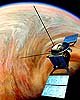
The European space probe Venus Express went into orbit around the planet on Tuesday after a 400-million-kilometer (250-million-mile) trip from Earth, mission controllers said. |
|
|

| The content herein, unless otherwise known to be public domain, are Copyright 1995-2006 - SpaceDaily.AFP and UPI Wire Stories are copyright Agence France-Presse and United Press International. ESA PortalReports are copyright European Space Agency. All NASA sourced material is public domain. Additionalcopyrights may apply in whole or part to other bona fide parties. Advertising does not imply endorsement,agreement or approval of any opinions, statements or information provided by SpaceDaily on any Web page published or hosted by SpaceDaily. Privacy Statement |