|
 |
 |
 |
 |
 |
 |
 |
 |
 |

| . |  |
. |
EU Launches WTO Counterclaim Against US
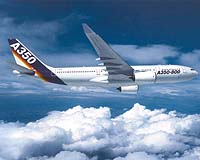
Washington (UPI) May 31, 2005 The European Union retaliated against the United States Tuesday launching a counterclaim in the World Trade Organization against U.S. aircraft manufacturer Boeing for receiving more than $29 billion in support from U.S. federal and state governments. EU Trade Commissioner Peter Mandelson made the announcement in Brussels Tuesday after the U.S. Trade Representative Office said Monday evening it would file a claim with the WTO to halt European governments from providing launch aid to Airbus in order to support the production of large civil aircraft. The United States formally filed its dispute Tuesday alleging the EU had violated the WTO's agreement on subsides and countervailing measures. "Europe and America are going head to head over the commercial rivalry of two companies, Airbus and Boeing, who should be left to compete in a global marketplace big enough to accommodate both," Mandelson said in a news conference. "It will be hard fought on both sides, and I can assure you Europe's interests will be fully defended." Brussels and Washington have been trying to reach a negotiated settlement even after formal talks broke down April 11. During the three-month negotiation period that began in January both parties agreed not to pursue litigation or the use of subsidies to develop large civil aircraft; however, no resolution was obtained over the issue of ending subsidies. Washington has been adamant that the use of launch aid - governmental loans used to develop and produce large civil aircraft - by Airbus had to be halted. Though Brussels has been slow to stop the use of launch aid, on Friday the EU proposed to cut 30 percent of its launch investment for the new A350 if Boeing would also adhere to tighter restrictions on its own subsidies from defense contracts and U.S. governments. Washington rejected the proposal. "There was no appetite for compromise in Washington," said Mandelson. "Boeing demanded the complete, immediate renunciation by Airbus of all repayable, royalty-based launch investment as a prior condition to negotiation. In doing so, Boeing ensured that no negotiation took place. No commensurate balancing package was on offer at any stage to deal with Boeing's extensive multibillion dollar financing from the American taxpayer." The United States refused the proposal, saying a reduction in subsidies was not an end to launch aid, which they claim has created an uneven playing field. "We cannot be negotiating if European member states are moving ahead for additional launch aid for Airbus," a U.S. trade official said in a conference call with reporters Tuesday. "In light of that and the unwillingness of Europe to halt these supports we have decided that it is necessary to go forward with the case in the WTO." In Brussels, Mandelson argued that Boeing has received more than $29 billion in support from U.S. federal and state governments, defense contracts and launch investment since 1992, compared to Airbus, which has only received $3.7 billion. According to the European Commission trade office, Boeing has received $3.2 billion worth of tax incentives and $4.2 billion in subsidies for infrastructure from Washington state, $1.6 billion in launch investment from Japan and more than $20 billion from research and development funding from NASA and the U.S. Department of Defense. "I certainly don't know where or how he calculated those numbers. They certainly don't accord with our sense of magnitude of the support given to Airbus or Boeing that they may have received," said a U.S. trade official. Washington has also argued that research and development contracts with providers are not free grants and are not subject to the definitions of subsidies under the WTO agreement. "We think there is a difference between giving someone a risk-free grant or loan vs. a contract for a particular good or service. Those are true commercial transactions that don't fall under the subsidies definition," said a U.S. trade official. Despite the EU's issuing a complaint to the WTO, U.S. trade officials said their focus would stay on the subsidies provided by European governments to Airbus. "We'll have to see what allegations the European Union makes in its case and then we'll respond appropriately and we think effectively," said a U.S. trade official. Mandelson explained that the rush by the United States to head to the WTO was the result of "instrumental" pressure made on the part of Boeing, which he argued forced the case to the WTO "not because it fears subsidy but because it fears competition." Despite both parties' confidence over the strength of their individual cases, both Washington and Brussels stressed that transatlantic relations would not be hindered, despite the biggest trade dispute before the WTO. Related Links SpaceDaily Search SpaceDaily Subscribe To SpaceDaily Express  Towards A Small Aircraft Transportation System For The 21st Century
 Washington (UPI) May 31, 2005
Washington DC (SPX) Jun 06, 2005 Imagine taking a safe, fast, small airplane from a neighborhood airport to visit your family 600 miles away. Imagine almost door-to-door, on-demand service that means you may never see a crowded, major hub airport again. |
|
|

| The content herein, unless otherwise known to be public domain, are Copyright 1995-2006 - SpaceDaily.AFP and UPI Wire Stories are copyright Agence France-Presse and United Press International. ESA PortalReports are copyright European Space Agency. All NASA sourced material is public domain. Additionalcopyrights may apply in whole or part to other bona fide parties. Advertising does not imply endorsement,agreement or approval of any opinions, statements or information provided by SpaceDaily on any Web page published or hosted by SpaceDaily. Privacy Statement |