|
 |
 |
 |
 |
 |
 |
 |
 |
 |

| . |  |
. |
Early Humans Adapted Well To Different Climates
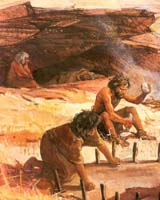
Arlington VA (SPX) Aug 05, 2004 Early human ancestors seem to have taken different climates and vegetation types in stride as they evolved from apelike populations in Africa to a worldwide, highly diverse human species. New research supported in part by the National Science Foundation (NSF) demonstrates that hominins (early human species) in what is today northern Africa lived equally well in a relatively warm and dry climate 3.4 million years ago and in a much cooler climate with significantly more rainfall and forest growth slightly later. And the species studied, Australopithecus afarensis, adapted to these dramatic environmental changes without the benefit of an enlarged brain or stone tools, which aided later hominins in adapting to their environments. These research results appear in the Proceedings of the National Academy of Sciences now online. The studies are part of a large on-going project that explores the emergence and amplification of human adaptability in the past 4 million years. "This article focuses on human adaptability in environmentally dynamic settings," said program officer, Mark Weiss. "As humans evolved, they faced many challenges. It is important to know how they met these challenges." These findings contribute to an ongoing debate about whether hominins of the Pliocene era preferred settings that were open and arid or wooded and moist - or whether they could adapt well to diverse environments. A lack of data on changes in past ecosystems to compare with hominin fossil data has hampered the inquiry. Richard Potts of the Smithsonian Institution's National Museum of Natural History and other team members analyzed fossil pollen located in stratified rock formations around Hadar, Ethiopia. From these samples, the team identified three persistent plant communities: steppe, and tropical and temperate forests containing water-conserving plants. A fourth plant community, forests containing plants that grow in cooler and wetter climates, appears and disappears in the pollen record. The presence of this fourth community corresponds with climate records of cooler and wetter periods in Hadar. "These early humans had a surprising ability to adapt to environmental changes," says Potts. "They could live in arid grasslands and forested surroundings as well." The research was carried out in collaboration with French research team led by Raymonde Bonnefille of the CNRS, Aix-en-Provence, France. Related Links Smithsonian National Museum of Natural History SpaceDaily Search SpaceDaily Subscribe To SpaceDaily Express  NHGRI Adds 18 Organisms To Sequencing Pipeline
 Bethesda MD (SPX) Aug 05, 2004
As part of its ongoing effort to enhance understanding of the human genome, the National Human Genome Research Institute (NHGRI), one of the National Institutes of Health, announced Wednesday that the Large-Scale Sequencing Research Network has received the green light to begin sequencing 18 strategically selected organisms, including the orangutan, African savannah elephant and domestic cat. |
|
|

| The content herein, unless otherwise known to be public domain, are Copyright 1995-2006 - SpaceDaily.AFP and UPI Wire Stories are copyright Agence France-Presse and United Press International. ESA PortalReports are copyright European Space Agency. All NASA sourced material is public domain. Additionalcopyrights may apply in whole or part to other bona fide parties. Advertising does not imply endorsement,agreement or approval of any opinions, statements or information provided by SpaceDaily on any Web page published or hosted by SpaceDaily. Privacy Statement |