|
 |
 |
 |
 |
 |
 |
 |
 |
 |

| . |  |
. |
Earth-Moon Observations From Venus Express
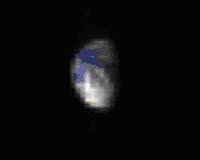
Paris (ESA) Nov 28, 2005 A recent check of the VIRTIS imaging spectrometer during the Venus Express commissioning phase has allowed its first remote-sensing data to be acquired, using Earth and the Moon as a reference. After a successful in-flight checkout of the spacecraft's systems in the first ten days of flight, the ESOC operations team is now verifying the health and functioning of all the Venus Express instruments. These observations were made as part of this checkout. Of course the very large distance that Venus Express has travelled since its launch makes these images of limited interest to the general public, but to the scientific team it confirms the excellent operation of their instrument. This gives them confidence of spectacular results when the spacecraft reaches Venus where similar measurements will be made hundreds times closer. VIRTIS sees the Earth-Moon system Only two weeks after the launch, VIRTIS, the Ultraviolet/Visible/Near-Infrared mapping spectrometer, has been able to make its first planetary observations, capturing the Earth-Moon system. "The observations were made from 3.5 million kilometres away, with a phase angle of 65 degrees, meaning that 65% of the Earth's disk was illuminated by the Sun, providing observations of both the day and night sides of the Earth," explains Guiseppe Piccioni, one of the two Principal Investigators (PI). These Earth observations will be used to test the instrument on a real planetary case, before Venus approach. "A comparison of Venus spectra with Earth spectra with the same instrument will also be of interest for textbook illustration of the comparison between the two planets," explained Pierre Drossart, the other PI. The Moon has also been observed, providing additional observations of particular interest for calibrating the intrument. The VIRTIS instrument on Venus Express is a twin of the same instrument on Rosetta, and similar observations were sent back by Rosetta in March 2005, so comparisons of the two sets of observations will be very useful for calibration purposes. The VIRTIS instrument is led jointly by INAF-IASF, Rome, Italy, and Observatoire de Paris, France. Related Links Venus Express at ESA SpaceDaily Search SpaceDaily Subscribe To SpaceDaily Express  Tens Of Thousands Evacuated As Heavy Rains Drench Southern India
 Hyderabad, India (AFP) Oct 27, 2005
Tens of thousands of people have been evacuated as heavy rains lashed southern India for the third straight day Thursday, triggering floods, an official said. |
|
|

| The content herein, unless otherwise known to be public domain, are Copyright 1995-2006 - SpaceDaily.AFP and UPI Wire Stories are copyright Agence France-Presse and United Press International. ESA PortalReports are copyright European Space Agency. All NASA sourced material is public domain. Additionalcopyrights may apply in whole or part to other bona fide parties. Advertising does not imply endorsement,agreement or approval of any opinions, statements or information provided by SpaceDaily on any Web page published or hosted by SpaceDaily. Privacy Statement |