|
 |
 |
 |
 |
 |
 |
 |
 |
 |

| . |  |
. |
Eight Centuries Of Water Management Have Taught The Dutch To Think Ahead
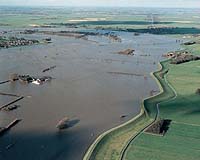
Gouda, Holland (AFP) Sep 07, 2005 For some eight centuries the Dutch have protected their low-lying land with an intricate system of dams and dikes to keep their feet dry in a country that would have been engulfed by water if man had not intervened. The saying goes that God created the earth but the Dutch created the Netherlands. Indeed the Dutch ministry of Transport and Public works calculates that 66 percent of the Netherlands would be submerged without the 3,500 kilometers (2,190 miles) of dams, dikes and dunes maintained by special water boards. Dutch experts in water management are on hand to help with the New Orleans flooding and the US are importing Dutch water pumps to help drain the area. Some 25 percent of the Netherlands lies below sea level and with a myriad of deltas, rivers and streams it is confronted with much the same problems as New Orleans. In 1953 the Netherlands suffered a devastating flood that killed more than 2,000 people in the southwest of the country, prompting the government to take action to reinforce the system of dikes and dams. But the Dutch perpetual fight against the water started much earlier. "Here you find yourself in one of the oldest water management systems of the Netherlands," Hans van den Hoek, a spokesman for the Rijnland dike board or Hoogheemraadschap, told AFP. The board is charged with water management in a territory that stretches over 1,000 square kilometres from the North Sea coast to Amsterdam and central Gouda. For eight centuries the Rhine river has crossed this territory, the river bed moving south over time. When the river delta silted up threatening to inundate the region, the inhabitants formed a democratically elected board -- the first in the Netherlands-- to manage the water and drain submerged areas to create new farm land. Van den Hoek is speaking from the control room of a pumping station, a stone's throw from Gouda. Now computers manage the mechanical water pumps that replaced the windmills in 1933. "In spite of modern technology man is still at the centre of all this because a computer could never surpass the centuries of experience we have in measuring the solidity of the dikes or checking the depth of a canal," Van den Hoek said. Nowadays the task of the water board is twofold, making sure the Dutch keep their feet dry and ensuring water quality. Some 450 people, overseen by a so-called dike warden, check the canals and dikes that lead the water to the principal canals and eventually the rivers or the sea. The board also has to protect the area against the salt sea water. "The dunes you see along the Dutch coast are painstakingly maintained. They are as wide and high as possible because they have to resist everything up to a storm and flood that we would statistically see once every 10,000 years," Van den Hoek explained. He would not speculate on what went wrong in New Orleans but stressed that the 'Dutch way' of water management also relied on a degree of providence from the people here. "I have a profound respect for water. It is a phenomenal force and that is why with each dike we construct we try to prepare for the worst," he said. "A this moment we are at the eve of a change of mentalities. We have to integrate climate changes in our system and foresee that there will be moments where we have to chase out the water but at other times we will have to let it in" to prevent droughts and preserve the right humidity level to prevent the dikes from drying out, which could lead to the dike breaking. In 1953 the Dutch providence was not enough. After the floods the government embarked on an unprecedented plan that dammed off dozens of kilometers of North Sea off the southwestern coast. "But whatever we do, nature always has the last word," Van den Hoek warned. Related Links SpaceDaily Search SpaceDaily Subscribe To SpaceDaily Express  Analysis: S.Korea Fears Water Control
 Yeoncheon, South Korea (UPI) Sep 06, 2005
South Korean residents living close to the border with North Korea were again reminded of the perils of living next to the communist state. The South Koreans, mostly farmers and fishermen on the Imjin River that flows along the border, were surprised as North Korea released a massive amount of water from a dam just north of the Demilitarized Zone separating the two Koreas. |
|
|

| The content herein, unless otherwise known to be public domain, are Copyright 1995-2006 - SpaceDaily.AFP and UPI Wire Stories are copyright Agence France-Presse and United Press International. ESA PortalReports are copyright European Space Agency. All NASA sourced material is public domain. Additionalcopyrights may apply in whole or part to other bona fide parties. Advertising does not imply endorsement,agreement or approval of any opinions, statements or information provided by SpaceDaily on any Web page published or hosted by SpaceDaily. Privacy Statement |