
 |
 |
 |
 |
 |
 |
 |
 |
 |
 |

| . |  |
. |

Paris (AFP) July 7, 2010 A billion-euro (1.25-billion-dollar) European spacecraft will get up close and personal with an asteroid this Saturday as the probe blasts through the Solar System on its way to rendezvous with a comet. The flyby comes halfway in the extraordinary tale of the European Space Agency's Rosetta, launched in 2004 on a 12-year, 7.1-billion-kilometre (4.4-billion-mile) mission. One of the biggest gambles in the history of space exploration, the unmanned explorer is designed to meet up in 2014 with Comet 67/P Churyumov-Gerasimenko 675 million kms (422 million miles) from home. The goal is to unlock the secrets of these lonely wanderers of the cosmos, whose origins date back to the dawn of the Solar System, some 4.5 billion years ago, before planets existed. To get to its distant meeting point, Rosetta has had to play planetary billiards for five years, using four "gravitational assists" from Earth and Mars as slingshots to build up speed. Now racing through the asteroid belt between Mars and Jupiter at 47,800 kph (29,925 mph), Rosetta on Saturday will come within 3,200 kms (2,000 miles) of a potato-shaped rock, Lutetia. The two-hour flyby is Rosetta's second swing past an asteroid in its trek but offers by far the best chance of a harvest for its battery of scientific instruments, said Gerhard Schwehm, Rosetta's mission manager. Lutetia, measuring 134 kms (83.75 miles) in diameter, "is a massive object and the flyby is relatively close, which means there will be a little disturbance of our trajectory," Schwehm said in an interview. "It will be a very, very tiny deviation, but enough for us to measure (Lutetia's) mass, and with the data on its image and shape, that will give us a handle on its density." Such knowledge could one day be a lifesaver, explained Schwehm. If a rogue asteroid enters on a collision course with Earth, knowing its density will help the planet's defenders to determine whether they should try to deflect the rock or, instead, blow it up. Once widely dismissed as bland lumps of debris left over from the building of the planets, asteroids have turned out to be intriguingly individual. They are extremely different in shape and size, from just hundreds of metres (yards) across to behemoths of 100 kms (60 miles) or more, and also vary in mineral flavours. Most measurements suggest Lutetia is a "C" type of asteroid, meaning that it contains primitive compounds of carbon. But others indicate it could be an "M" type, meaning that it holds metals. "If Lutetia is a metallic asteroid, then we have found a real winner," said Rita Schulz, a Rosetta project scientist. For one thing, it could rewrite the theory about asteroid classification. Metallic asteroids are far smaller than Lutetia: they are deemed to be fragments of far larger rocks that, in the bump and grind of the asteroid belt, were smashed apart. In July next year, Rosetta goes into deep hibernation to save power. If all goes well, it will wake up in January 2014 and then send down a refrigerator-sized lab called Philae, which will anchor onto the comet's icy crust and carry out tests of its surface. For all their scientific rigour, the Rosetta team will be crossing every finger that the Big Sleep will go well, admitted Schwehm. "You don't want in your wildest dreams to be sitting there in 2014 and the little beast doesn't switch on," he said wryly.
Share This Article With Planet Earth
Related Links Asteroid and Comet Mission News, Science and Technology

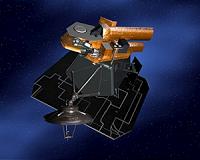 Earth To Lend Helping Hand To Comet Craft
Pasadena CA (SPX) Jun 28, 2010 NASA's Deep Impact/EPOXI spacecraft will fly past Earth this Sunday (June 27). Mission navigators have tailored this trajectory so the spacecraft can "hitch a ride" on Earth's gravity field, which will help propel the mission toward its appointment with comet Hartley 2 this fall. At time of closest approach to Earth, the spacecraft will be about 30,400 kilometers (18,900 miles) above the S ... read more |
|
|
| The content herein, unless otherwise known to be public domain, are Copyright 1995-2010 - SpaceDaily. AFP and UPI Wire Stories are copyright Agence France-Presse and United Press International. ESA Portal Reports are copyright European Space Agency. All NASA sourced material is public domain. Additional copyrights may apply in whole or part to other bona fide parties. Advertising does not imply endorsement,agreement or approval of any opinions, statements or information provided by SpaceDaily on any Web page published or hosted by SpaceDaily. Privacy Statement |


 del.icio.us
 Digg
Digg Reddit
 YahooMyWeb
 Google
 Facebook


