
. Military Space News .
INTERN DAILY
Exeter scientists call for reduction in plastic lab waste
by Staff Writers
Exeter UK (SPX) Dec 30, 2015


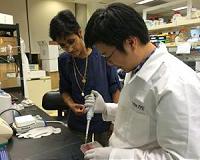
File image.

Three researchers at the University of Exeter are calling for action to cut down on the five and a half million tonnes of plastic being generated globally in the course of scientific research.

In a Correspondence article entitled 'Labs should cut plastic waste too' published in the journal Nature this week, they estimate that bio scientific research is responsible for 1.8 per cent of total global plastic production, waste which weighs the equivalent of 67 cruise ships a year.

Drs Mauricio Urbina, Andrew Watts and Erin Reardon estimated that the 280 scientists in their own bioscience department at the University of Exeter generated roughly 267 tonnes of plastic waste last year. On the basis of this, they worked out that the 20,543 biologically-oriented research institutions worldwide will be producing 5.5 million tonnes of plastic waste between them.

"As scientists, our day- to- day research relies on cheap, durable, disposable plastic. We are forced to maximize value of research budgets, and often rely on cheap disposable plastic equipment which means ignoring the environmental consequences," said lead author Dr Urbina.

Their article urges the research community and funders to prioritise the potential environmental impact of plastics over the cost of research and take measures to reduce single use plastic waste.

"When we started doing the calculations for this exercise, using data provided by the University of Exeter Sustainability Office, I expected the contribution of research to the global plastic problem to be almost negligible - but we were surprised at how high the estimate is", commented Dr Reardon.

"At a time when governments are imposing charges for single use plastic bags and bottles, we think the scientific research community could be working towards reducing its dependency on plastic, and could be doing so without sacrificing scientific standards."

The authors say they are aware of the challenges faced in obtaining research funding and on keeping costs low. "However, we should not use disposable plastic items only on the basis of cost and the time saved. Does scientific research have to follow the market rules of producing peer-review papers at the lowest cost?" added Dr Urbina.

"I don't think it's possible to completely remove plastic equipment, for reasons of contamination and biological hazards, but there are definitely ways in which some items can be re-used. We want to challenge scientists to think about what they use and to see if they can reduce it. We see this very much as a starting point in an ongoing discussion," said Dr Watts.

The article proposes that funding agencies might incentivize greener practice with a budget to fund lab washing up and recycling facilities and by making it a requirement of the grant application process.

Labs should cut plastic waste too by Mauricio A. Urbina, Andrew J. R. Watts and Erin E. Reardon is published in Nature on Wednesday December 23 2015.


Thanks for being here;
We need your help. The Space Media Network continues to grow but revenues have never been harder to maintain.

With the rise of Ad Blockers, and Facebook - our traditional revenue sources via quality network advertising continues to decline. And unlike so many other news sites, we don't have a paywall - with those annoying usernames and passwords.

Our news coverage takes time and effort to publish 365 days a year.

If you find our news sites informative and useful then please consider becoming a regular supporter or for now make a one off contribution.
SpaceMediaNetwork Contributor
$5 Billed Once


credit card or paypal
SpaceMediaNetwork Monthly Supporter
$5 Billed Monthly


paypal only


.


Related Links
University of Exeter
Hospital and Medical News at InternDaily.com


Comment on this article via your Facebook, Yahoo, AOL, Hotmail login.

Share this article via these popular social media networks
del.icio.usdel.icio.us DiggDigg RedditReddit GoogleGoogle

Previous Report
INTERN DAILY
Researchers develop new method for looking into the lungs
Aarhus, Denmark (SPX) Dec 28, 2015
For the first time, researchers have succeeded in producing 3D images showing oxygen and CO2 transport in the lungs. The new method provides hope for better treatment of COPD and lung cancer. Every time we breathe, oxygen and CO2 is transferred between our blood and the air in the lungs. It is crucial for us to maintain life that this gas transport functions, and detailed knowledge about t ... read more


INTERN DAILY
Germany withdraws Patriot missiles from Turkey

Israeli missile interceptor passes final test

New SBIRS ground system celebrates two major milestones

Aegis Ashore missile defense system goes online in Romania

INTERN DAILY
Poland acquiring air defense system

Iran says it will not accept any missile restrictions

Russian cruise missile crashes on building, no one hurt

Iran missile launch violated UN resolution: UN experts

INTERN DAILY
Drone helps icebreaker navigate treacherous Antarctic

Army unit retires Hunter unmanned aircraft systems

Italy receives Predator-A drones

New NATO UAV completes flight test

INTERN DAILY
Elbit upgrades tactical intelligence capabilities for Asian country

New tactical radio order for Harris Corporation

Preparing for the Unexpected in Space

General Dynamics to provide communications for USAFCENT in Asia

INTERN DAILY
Forensic seismology tested on 2006 munitions depot 'cook-off' in Baghdad

German Army orders more Boxer armored vehicles

Lockheed Martin suing over lost combat vehicle contract

Oshkosh resumes JLTV work after Lockheed protest dismissed

INTERN DAILY
Italy's Finmeccanica reorganizes

India to purchase Russian S-400 Triumf defense system

U.S. Army awards $1.05 billion D3I contract

Japan, Indonesia agree on defence technology transfer talks

INTERN DAILY
Okinawa countersues Japanese government over US base move

Japan PM faces make-or-break test three years later

PM Abe's cabinet approves largest defence budget

Japan spots cannon-like equipment on Chinese ship near disputed isles

INTERN DAILY
New acoustic technique reveals structural information in nanoscale materials

Program seeks ability to assemble atom-sized pieces into practical products

Nanodevices at one-hundredth the cost

Scientists blueprint tiny cellular 'nanomachine'


The content herein, unless otherwise known to be public domain, are Copyright 1995-2024 - Space Media Network. All websites are published in Australia and are solely subject to Australian law and governed by Fair Use principals for news reporting and research purposes. AFP, UPI and IANS news wire stories are copyright Agence France-Presse, United Press International and Indo-Asia News Service. ESA news reports are copyright European Space Agency. All NASA sourced material is public domain. Additional copyrights may apply in whole or part to other bona fide parties. All articles labeled "by Staff Writers" include reports supplied to Space Media Network by industry news wires, PR agencies, corporate press officers and the like. Such articles are individually curated and edited by Space Media Network staff on the basis of the report's information value to our industry and professional readership. Advertising does not imply endorsement, agreement or approval of any opinions, statements or information provided by Space Media Network on any Web page published or hosted by Space Media Network. General Data Protection Regulation (GDPR) Statement Our advertisers use various cookies and the like to deliver the best ad banner available at one time. All network advertising suppliers have GDPR policies (Legitimate Interest) that conform with EU regulations for data collection. By using our websites you consent to cookie based advertising. If you do not agree with this then you must stop using the websites from May 25, 2018. Privacy Statement. Additional information can be found here at About Us.