Subscribe free to our newsletters via your
. Military Space News .


MARSDAILY
Exhumed rocks reveal Mars water ran deep
by Staff Writers
Paris, France (ESA) Jun 29, 2012


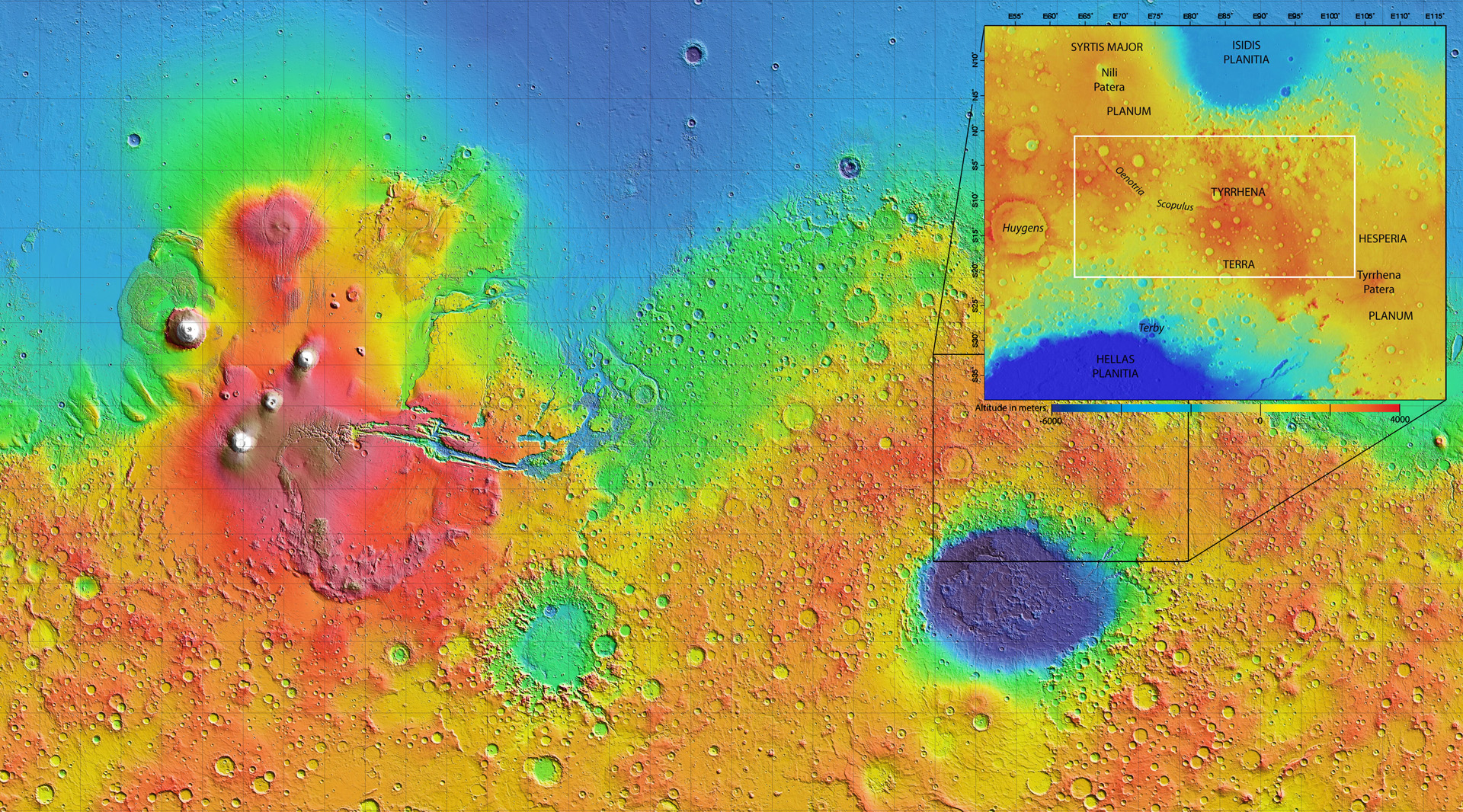
The 1000 x 2000 km area region of Tyrrhena Terra (outlined by the white box in the inset) sits between two regions of low altitude - Hellas Planitia and Isidis Planitia - in Mars' southern hemisphere, as shown in this global topography map. Hydrated minerals were found in 175 locations associated with impact craters in Tyrrhena Terra, such as inside the walls of craters, along crater rims, or in material excavated by the impact. Analysis suggests that these minerals were formed in the presence of water that persisted at depth for an extended period of time. Credits: NASA/MOLA Science Team /D. Loizeau et al. For a larger version of this image please go here.

By studying rocks blasted out of impact craters, ESA's Mars Express has found evidence that underground water persisted at depth for prolonged periods during the first billion years of the Red Planet's existence. Impact craters are natural windows into the history of planetary surfaces - the deeper the crater, the further back in time you can probe.

In addition, rocks blasted out during the impact offer a chance to study material that once lay hidden beneath the surface.

In a new study, ESA's Mars Express and NASA's Mars Reconnaissance Orbiter zoomed in on craters in a 1000 x 2000 km region of the ancient southern highlands, called Tyrrhena Terra, to learn more about the history of water in this region.

Focusing on the chemistry of rocks embedded in the crater walls, rims and central uplifts, as well as the surrounding exhumed material, scientists identified 175 sites bearing minerals formed in the presence of water.

"The large range of crater sizes studied, from less than 1 km to 84 km wide, indicates that these hydrated silicates were excavated from depths of tens of metres to kilometres," says Damien Loizeau, lead author of the study.

"The composition of the rocks is such that underground water must have been present here for a long period of time in order to have altered their chemistry."

While the material excavated by impacts appears to have been in close contact with water, there is little evidence for rocks on the surface lying between the craters in Tyrrhena Terra having been altered by water.

"Water circulation occurred several kilometres deep in the crust some 3.7 billion years ago, before the majority of craters formed in this region," says co-author Nicolas Mangold.

"The water generated a diverse range of chemical changes in the rocks that reflect low temperatures near the surface to high temperatures at depth, but without a direct relationship to the surface conditions at that time."

By comparison, Mawrth Vallis, one of the largest identified clay-rich regions of Mars, displays a more uniform aqueous mineralogy that indicates a closer link with surface processes.

"The role of liquid water on Mars is of great importance for its habitability and this study using Mars Express describes a very large zone where groundwater was present for a long time," says Olivier Witasse, ESA's Mars Express project scientist.

.


Related Links
Mars Express
Mars News and Information at MarsDaily.com
Lunar Dreams and more


Comment on this article via your Facebook, Yahoo, AOL, Hotmail login.

Share this article via these popular social media networks
del.icio.usdel.icio.us DiggDigg RedditReddit GoogleGoogle


MARSDAILY
Extensive Water in Mars Interior
Washington DC (SPX) Jun 25, 2012
Until now, Earth was the only planet known to have vast reservoirs of water in its interior. Scientists analyzed the water content of two Martian meteorites originating from inside the Red Planet. They found that the amount of water in places of the Martian mantle is vastly larger than previous estimates and is similar to that of Earth's. The results not only affect what we know abou ... read more


MARSDAILY
U.S., Israel map out joint missile plan

Turkey to pick new missile defence system soon

Amid rocket battle, upgrade for Iron Dome

Boeing Completes Upgrade of AEOS Telescope at Maui Space Surveillance Complex

MARSDAILY
Lockheed Martin Awarded Contract for MLRS M270A1 Launcher Cab Upgrades

Northrop Grumman to Deliver Advanced Threat Warning Sensors to the U.S. Navy

Two Russians convicted of treason over missile data

Javelin Missile Proves New Capability during Vehicle-Launched Norwegian Tests

MARSDAILY
Drones: pros and cons

UN urges answers on US drone attacks, targeted killings

Northrop Grumman Unveils U.S. Navy's First MQ-4C BAMS Unmanned Aircraft

X-47B Flight Testing Completed at Edwards Second Aircraft Moved to East Coast

MARSDAILY
Lockheed Martin Selected to Manage Major Defense Information Systems Network Operations

Lockheed Martin Selected to Deliver Major Improvements to DoD's ISR Information Sharing Capabilities

Boeing FAB-T Demonstrates Communications with On-orbit AEHF Satellite

Lockheed Martin Completes Environmental Testing on Second US Navy Satellite

MARSDAILY
Boeing Completes Wind Tunnel Tests on Silent Eagle Conformal Weapons Bay

Taiwan, US to sign fighter radar contract: report

Portuguese armor vehicle to test in Brazil

Northrop Grumman Demonstrates Joint Threat Emitter for NAS Whidbey Island

MARSDAILY
Brazil leads region in defense spending

Crisis time nears for India's cadet pilots

Eurocopter shows off X-3

United Technologies sold military software to China: US

MARSDAILY
China marks HK handover anniversary with local military parade

China vows to oppose military provocation

Outside View: 21st century strategy needed

Outside View: 'Reset' with Russia

MARSDAILY
Nanodiamonds cut through dirt to bring back 'bling' to low temperature laundry

Research team develops world's most powerful nanoscale microwave oscillators

Researchers test carbon nanotube-based ultra-low voltage integrated circuits

Researchers tune the strain in graphene drumheads to create quantum dots


The content herein, unless otherwise known to be public domain, are Copyright 1995-2014 - Space Media Network. AFP, UPI and IANS news wire stories are copyright Agence France-Presse, United Press International and Indo-Asia News Service. ESA Portal Reports are copyright European Space Agency. All NASA sourced material is public domain. Additional copyrights may apply in whole or part to other bona fide parties. Advertising does not imply endorsement,agreement or approval of any opinions, statements or information provided by Space Media Network on any Web page published or hosted by Space Media Network. Privacy Statement