
 |
 |
 |
 |
 |
 |
 |
 |
 |
 |

| . |  |
. |

Barcelona, Spain (SPX) May 19, 2011 Most mechanical resonators damp (slow down) in a well-understood linear manner, but ground-breaking work by Prof. Adrian Bachtold and his research group at the Catalan Institute of Nanotechnology has shown that resonators formed from nanoscale graphene and carbon nanotubes exhibit nonlinear damping, opening up exciting possibilities for super-sensitive detectors of force or mass. In an article to be published in Nature Nanotechnology Prof. Bachtold and his co-researchers describe how they formed nano-scale resonators by suspending tiny graphene sheets or carbon nanotubes and clamping them at each end. These devices, similar to guitar strings, can be set to vibrate at very specific frequencies. In all mechanical resonators studied to date, from large objects several metres in size down to tiny components just a few tens of nanometers in length, damping has always been observed to occur in a highly predictable, linear manner. However Prof. Bachtold's research demonstrates that this linear damping paradigm breaks down for resonators with critical dimensions on the atomic scale. Of particular importance they have shown that the damping is strongly nonlinear for resonators based on nanotubes and graphene, a characteristic that facilitates amplification of signals and dramatic improvements in sensitivity. The finding has profound consequences. Damping is central to the physics of nanoelectromechanical resonators, lying at the core of quantum and sensing experiments. Therefore many predictions that have been made for nanoscale electro-mechanical devices now need to be revisited when considering nanotube and graphene resonators. This new insight into the dynamics of nano-scale resonators will also enable dramatic improvements in the performance of numerous devices. Already the Prof. Bachtold's group has achieved a new record in quality factor for graphene resonators and ultra-weak force sensing with a nanotube resonator. The work is particularly timely because an increasing number of research groups around the world with diverse backgrounds are choosing to study nanotube/graphene resonators, which have a number of uniquely useful properties.
Share This Article With Planet Earth
Related Links - Nano Technology News From SpaceMart.com Computer Chip Architecture, Technology and Manufacture

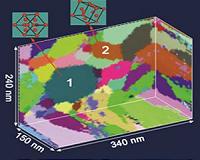 Looking inside nanomaterials in three dimensions
Frederiksborgvej, Denmark (SPX) May 19, 2011 The journal Science has published a paper where scientists from Riso DTU in collaboration with scientists from China and USA, have reported a new method for revealing a 3D picture of the structure inside a material. Most solid materials are composed of millions of small crystals, packed together to form a fully dense solid. The orientations, shapes, sizes and relative arrangement of these ... read more |
|
|
| The content herein, unless otherwise known to be public domain, are Copyright 1995-2010 - SpaceDaily. AFP and UPI Wire Stories are copyright Agence France-Presse and United Press International. ESA Portal Reports are copyright European Space Agency. All NASA sourced material is public domain. Additional copyrights may apply in whole or part to other bona fide parties. Advertising does not imply endorsement,agreement or approval of any opinions, statements or information provided by SpaceDaily on any Web page published or hosted by SpaceDaily. Privacy Statement |


 del.icio.us
 Digg
Digg Reddit
 YahooMyWeb
 Google
 Facebook


