|
 |
 |
 |
 |
 |
 |
 |
 |
 |

| . |  |
. |
Exploding Stars Influence Climate Of Earth
Copenhagen, Denmark (SPX) Oct 06, 2006 A team at the Danish National Space Center has discovered how cosmic rays from exploding stars can help to make clouds in the atmosphere. The results support the theory that cosmic rays influence Earth's climate. An essential role for remote stars in everyday weather on Earth has been revealed by an experiment at the Danish National Space Center in Copenhagen. It is already well-established that when cosmic rays, which are high-speed atomic particles originating in exploded stars far away in the Milky Way, penetrate Earth's atmosphere they produce substantial amounts of ions and release free electrons. Now, results from the Danish experiment show that the released electrons significantly promote the formation of building blocks for cloud condensation nuclei on which water vapour condenses to make clouds. Hence, a causal mechanism by which cosmic rays can facilitate the production of clouds in Earth's atmosphere has been experimentally identified for the first time. The Danish team officially announced their discovery on Wednesday in Proceedings of the Royal Society A, published by the Royal Society, the British national academy of science.
The experiment The experiment called SKY (Danish for "cloud") took place in a large reaction chamber which contained a mixture of gases at realistic concentrations to imitate the chemistry of the lower atmosphere. Ultraviolet lamps mimicked the action of the Sun's rays. During experimental runs, instruments traced the chemical action of the penetrating cosmic rays in the reaction chamber. The data revealed that electrons released by cosmic rays act as catalysts, which significantly accelerate the formation of stable, ultra-small clusters of sulphuric acid and water molecules which are building blocks for the cloud condensation nuclei. A vast numbers of such microscopic droplets appeared, floating in the air in the reaction chamber. "We were amazed by the speed and efficiency with which the electrons do their work of creating the building blocks for the cloud condensation nuclei," says team leader Henrik Svensmark, who is Director of the Center for Sun-Climate Research within the Danish National Space Center. "This is a completely new result within climate science."
A missing link in climate theory The experimental results lend strong empirical support to the theory proposed a decade ago by Henrik Svensmark and Eigil Friis-Christensen that cosmic rays influence Earth's climate through their effect on cloud formation. The original theory rested on data showing a strong correlation between variation in the intensity of cosmic radiation penetrating the atmosphere and the amount of low-altitude clouds. Cloud cover increases when the intensity of cosmic rays grows and decreases when the intensity declines. It is known that low-altitude clouds have an overall cooling effect on the Earth's surface. Hence, variations in cloud cover caused by cosmic rays can change the surface temperature. The existence of such a cosmic connection to Earth's climate might thus help to explain past and present variations in Earth's climate. Interestingly, during the 20th Century, the Sun's magnetic field which shields Earth from cosmic rays more than doubled, thereby reducing the average influx of cosmic rays. The resulting reduction in cloudiness, especially of low-altitude clouds, may be a significant factor in the global warming Earth has undergone during the last century. However, until now, there has been no experimental evidence of how the causal mechanism linking cosmic rays and cloud formation may work. "Many climate scientists have considered the linkages from cosmic rays to clouds to climate as unproven," comments Eigil Friis-Christensen, who is now Director of the Danish National Space Center. "Some said there was no conceivable way in which cosmic rays could influence cloud cover. The SKY experiment now shows how they do so, and should help to put the cosmic-ray connection firmly onto the agenda of international climate research." Published online in "Proceedings of the Royal Society A", October 3rd Title: "Experimental Evidence for the role of Ions in Particle Nucleation under Atmospheric Conditions". Authors: Henrik Svensmark, Jens Olaf Pepke Pedersen, Nigel Marsh, Martin Enghoff and Ulrik Uggerhoj. Related Links Danish National Space Center Stellar Chemistry, The Universe And All Within It Learn about Climate Science at TerraDaily.com  ESA Planck Satellite Builds On Nobel-Prize-Winning Science
 Paris France (ESA) Oct 04, 2006
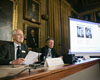
The 2006 Nobel Prize for physics has been awarded to Americans John C. Mather and George F. Smoot for their work on NASA's 1989 Cosmic Background Explorer (COBE) satellite. In 2008, ESA's Planck satellite will be launched and will build on this award-winning legacy by showing cosmologists new details of the Universe's origins. |
|
|

| The content herein, unless otherwise known to be public domain, are Copyright 1995-2006 - SpaceDaily.AFP and UPI Wire Stories are copyright Agence France-Presse and United Press International. ESA PortalReports are copyright European Space Agency. All NASA sourced material is public domain. Additionalcopyrights may apply in whole or part to other bona fide parties. Advertising does not imply endorsement,agreement or approval of any opinions, statements or information provided by SpaceDaily on any Web page published or hosted by SpaceDaily. Privacy Statement |