|
 |
 |
 |
 |
 |
 |
 |
 |
 |

| . |  |
. |
FUSE Finds Young Solar System Awash In Carbon
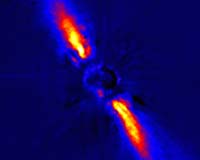
Greenbelt MD (SPX) Jun 07, 2006 Scientists using NASA's Far Ultraviolet Spectroscopic Explorer said Wednesday they have discovered abundant amounts of carbon gas in a dusty disk surrounding a young star named Beta Pictoris. The star and its emerging solar system are less than 20-million years old, and it already may have formed planets. The abundance of carbon gas in the remaining debris disk indicates Beta Pic's planets could be carbon-rich worlds of graphite and methane, or the star's environs might resemble Earth's solar system in its early days. Writing in the June 8 issue of Nature, a team led by Aki Roberge of NASA's Goddard Space Flight Center said the new measurements make Beta Pic the first disk of its kind whose gas has been comprehensively studied. The discovery settles a long-standing scientific mystery about how the gas has lingered in this debris disk, yet raises new questions about the development of solar systems. "There is much, much more carbon gas than anyone expected," Roberge said in a NASA news release. "Could this be what our own solar system looked like when it was young? Are we seeing the formation of new types of worlds? Either prospect is fascinating." The carbon gas detected by the spacecraft comes from unseen asteroids or comets orbiting the star that collide with each other and release material. The mere presence of gas in the Beta Pic disk has been a mystery. Theoretical models predict intense light from the young star should rapidly blow the gas away. The overabundance of carbon, discovered now for the first time, explains why the disk retains so much gas. Carbon is less susceptible to expulsion than other elements, and it retards the clearing effect. Beta Pictoris, about 60 light-years away from Earth, is 1.8 times more massive than the Sun. At 8-million to 20-million years old, it is very young. Its disk was discovered in 1984. Earlier observations with the Hubble Space Telescope and the Keck Telescope hinted that a Jupiter-like planet may have already formed in this disk, and rocky terrestrial planets may be forming. Such planets would be too small and faint to observe with current instruments. The terrestrial planets - Mercury, Venus, Earth and Mars - formed from the collision of smaller planetary bodies such as asteroids about 5-billion years ago. During the few hundred million years after Earth was formed, asteroids and comets might have smashed into the planet to deliver virtually all of the water and organic material that exist today. They are the building blocks of life on Earth. Asteroids and comets orbiting Beta Pic might contain large amounts of carbon-rich material, such as graphite and methane. Planets forming from or impacted by such bodies would be very different from those in the solar system and might have methane-rich atmospheres, such as Saturn's moon Titan. "What we have learned in the past ten years is that our galaxy is filled with other solar systems, and each one is different from the next," said co-researcher Marc Kuchner of NASA Goddard, an expert on extrasolar planets. "Beta Pictoris may be telling us something about the variety of planets that might be out there; some might be carbon planets, very different from the Earth." Alternatively, Beta Pic might be similar to the solar system as it existed long ago. Local asteroids and comets don't seem carbon-rich today, but some research suggests certain meteorites - called enstatite chondrite meteorites - formed in a carbon-rich environment. Some scientists also speculate Jupiter has a carbon core. Arthur C. Clarke, the science-fiction writer, once even suggested Jupiter's core is a diamond as big as Earth. "We might be observing processes that occurred early in our solar system's development," said Nature co-author Alycia Weinberger of the Carnegie Institution of Washington, D.C. Related Links Beta Pictoris background Grenoble Observatory ESO FUSE  Astronomers Find Planets With No Stars
 Washington DC (SPX) Jun 07, 2006
Astronomers said they have found planetary disks emerging independently of new stars or brown dwarfs. The disks have formed around planetary-mass objects, called planemos, and seem to be floating freely in space, after springing out of star-forming regions within the Milky Way galaxy. |
|
|

| The content herein, unless otherwise known to be public domain, are Copyright 1995-2006 - SpaceDaily.AFP and UPI Wire Stories are copyright Agence France-Presse and United Press International. ESA PortalReports are copyright European Space Agency. All NASA sourced material is public domain. Additionalcopyrights may apply in whole or part to other bona fide parties. Advertising does not imply endorsement,agreement or approval of any opinions, statements or information provided by SpaceDaily on any Web page published or hosted by SpaceDaily. Privacy Statement |