|
 |
 |
 |
 |
 |
 |
 |

| . |  |
. |

|
|
. |

 by Staff Writers Paris (AFP) Oct 16, 2011
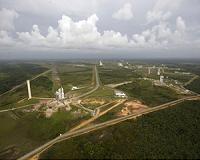
Following is a snapshot of Europe's Galileo space-based navigation system, the first satellites of which are scheduled to be launched on Thursday from Kourou, French Guiana. OVERVIEW: Galileo will consist of 30 satellites, six more than the US Global Positioning System (GPS). The system will offer several services from 2014, becoming fully operational in 2020 when a constellation of 27 satellites, supported by three spares, is deployed. Galileo's supporters say the system will be more accurate than the GPS and give Europe independence from the American system, which is run by the US government. Russia's GLONASS system and China's planned Compass systems are also government-run. HOW IT WORKS: Like GPS, Galileo works by the geometrical process called triangulation. The satellites emit synchronised signals in the 1.1-Gigahertz (GHz) band. Ground receivers capture the signals and compute the time it takes for each signal to arrive from their brief journey across space. Minute differences in time, caused by the varying distances, enable a calculation of the receiver's position on the Earth's surface. ORBITAL FIX: Galileo satellites will orbit at 23,200 kilometres (14,400 miles) in three orbital planes at a 56-degree angle to the Equator. This disposition helps coverage in cities, where tall buildings can disrupt coverage. With 27 operational satellites in orbit, there is a greater than 90 percent chance that someone anywhere on the planet -- including the north and south poles -- will be in direct line of at least four satellites. For most locations, six to eight satellites will be in direct line, making it possible to determine location to within a metre (3.25 feet). The GPS, which became operational in 1995 and is being upgraded, is currently accurate to between three and eight metres (10 and 26 feet). ATOMIC TIME-KEEPING: Galileo depends on atomic clocks to ensure that location data is precise. One billionth of a second too fast or too slow translates into an positioning error of about 30 centimetres (12 inches). The satellites will each contain four timepieces accurate to one second in three million years. In two hydrogen clocks, hydrogen atoms oscillate between two energy states to generate a signal in the form of an electromagnetic wave. Two compact rubidium clocks use the transition of the rubidium-87 atom between two hyperfine energy states. ROLLOUT: Two test satellites were launched in 2005 and 2008. The first two operational satellites are scheduled to be hoisted on October 20 by Soyuz, making the Russian rocket's maiden launch from Europe's spacebase. Two more will follow in 2012, forming the constellation's operational nucleus. Fourteen satellites should be in place by 2015 and able to offer three services, and the rest by 2020. The network will be managed by two control centres in Europe and sensor and uplink stations around the world. The system is designed to be compatible with GPS and Russia's GLONASS. COST: Initially estimated at 3.4 billion euros, the price tag was hiked by the European Commission earlier this year to 5.4 billion euros (7.2 billion dollars). Annual operating costs are estimated at 800 million euros for both Galileo and its precursor system, Egnos. The market for geo-positioning services will grow from 130 billion euros (180 billion dollars) in 2010 to 240 billion euros (330 billion dollars) in 2020, according to the EU executive. Sources: European Space Agency (ESA), European Commission, US government (GPS.gov)
GPS Applications, Technology and Suppliers
|
. |
|
| The content herein, unless otherwise known to be public domain, are Copyright 1995-2011 - Space Media Network. AFP and UPI Wire Stories are copyright Agence France-Presse and United Press International. ESA Portal Reports are copyright European Space Agency. All NASA sourced material is public domain. Additional copyrights may apply in whole or part to other bona fide parties. Advertising does not imply endorsement,agreement or approval of any opinions, statements or information provided by Space Media Network on any Web page published or hosted by Space Media Network. Privacy Statement |

 del.icio.us
 Digg
Digg Reddit
 Google