
 |
 |
 |
 |
 |
 |
 |
 |
 |
 |

| . |  |
. |

Batavia IL (SPX) Jul 27, 2010 New constraints on the elusive Higgs particle are more stringent than ever before. Scientists of the CDF and DZero collider experiments at the U.S. Department of Energy's Fermilab revealed their latest Higgs search results at the International Conference on High Energy Physics, held in Paris from July 22-28. Their results rule out a significant fraction of the allowed mass range established by earlier experiments. The Fermilab experiments now exclude a Higgs particle with a mass between 158 and 175 GeV/c2. Searches by previous experiments and constraints due to the Standard Model of Particles and Forces indicate that the Higgs particle should have a mass between 114 and 185 GeV/c2. (For comparison: 100 GeV/c2 is equivalent to 107 times the mass of a proton.) The new Fermilab result rules out about a quarter of the expected Higgs mass range. "Fermilab has pushed the productivity of the Tevatron collider to new heights," said Dennis Kovar, DOE Associate Director of Science for High Energy Physics. "Thanks to the extraordinary performance of Fermilab's Tevatron collider, CDF and DZero collaborators from around the world are producing exciting results and are making immense progress on the search for the Higgs particle." At the ICHEP conference, CDF and DZero scientists are giving more than 40 talks on searches for exotic particles and dark matter candidates, discoveries of new decay channels of known particles and precision measurements of numerous particle properties. Together, the two collaborations present about 150 results. The Higgs particle is the last not-yet-observed piece of the theoretical framework known as the Standard Model of Particles and Forces. According to the Standard Model, the Higgs boson explains why some particles have mass and others do not. "We are close to completely ruling out a Higgs boson with a large mass," said DZero co-spokesperson Dmitri Denisov, one of 500 scientists from 19 countries working on the DZero experiment. "Three years ago, we would not have thought that this would be possible. With more data coming in, our experiments are beginning to be sensitive to a low-mass Higgs boson." Robert Roser, co-spokesperson for the 550 physicists from 13 countries of the CDF collaboration, also credited the great work of the CDF and DZero analysis groups for the stringent Higgs exclusion results. "The new Higgs search results benefited from the wealth of Tevatron collision data and the smart search algorithms developed by lots of bright people, including hundreds of graduate students," Roser said. "The CDF and DZero analysis groups have gained a better understanding of collisions that can mimic a Higgs signal; improved the sensitivity of their detectors to particle signals; and included new Higgs decay channels in the overall analysis." To obtain the latest Higgs search result, the CDF and DZero analysis groups separately sifted through more than 500,000 billion proton-antiproton collisions that the Tevatron has delivered to each experiment since 2001. After the two groups obtained their independent Higgs search results, they combined their results to produce the joint exclusion limits. "Our latest result is based on about twice as much data as a year and a half ago," said DZero co-spokesperson Stefan Soldner-Rembold, of the University of Manchester. "As we continue to collect and analyze data, the Tevatron experiments will either exclude the Standard Model Higgs boson in the entire allowed mass range or see first hints of its existence." The observation of the Higgs particle is also one of the goals of the Large Hadron Collider experiments at the European laboratory CERN, which record proton-proton collisions that have 3.5 times the energy of Tevatron collisions. But for rare subatomic processes such as the production of a Higgs particle with a low mass, extra energy is less important than a large number of collisions produced. "With the Tevatron cranking out more and more collisions, we have a good chance of catching a glimpse of the Higgs boson," said CDF co-spokesperson Giovanni Punzi, of the University of Pisa and the National Institute of Nuclear Physics (INFN) in Italy. "It will be fascinating to see what Mother Nature has in her cards for us. We might find out that the Higgs properties are different from what we expect, revealing new insights into the origin of matter."
Share This Article With Planet Earth
Related Links Fermilab Understanding Time and Space

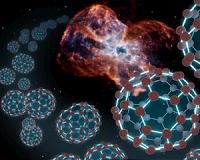 Elusive Buckyballs Found In Space For First Time
Pasadena CA (SPX) Jul 23, 2010 Astronomers using NASA's Spitzer Space Telescope have discovered carbon molecules, known as "buckyballs," in space for the first time. Buckyballs are soccer-ball-shaped molecules that were first observed in a laboratory 25 years ago. They are named for their resemblance to architect Buckminster Fuller's geodesic domes, which have interlocking circles on the surface of a partial sphere. Buc ... read more |
|
|
| The content herein, unless otherwise known to be public domain, are Copyright 1995-2010 - SpaceDaily. AFP and UPI Wire Stories are copyright Agence France-Presse and United Press International. ESA Portal Reports are copyright European Space Agency. All NASA sourced material is public domain. Additional copyrights may apply in whole or part to other bona fide parties. Advertising does not imply endorsement,agreement or approval of any opinions, statements or information provided by SpaceDaily on any Web page published or hosted by SpaceDaily. Privacy Statement |


 del.icio.us
 Digg
Digg Reddit
 YahooMyWeb
 Google
 Facebook


