. Military Space News .
Finding Planets By The Numbers

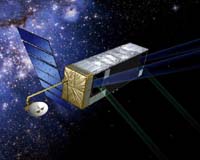
Artist concept of SIM PlanetQuest. Image credit: NASA/JPL
by Staff Writers
Washington DC (SPX) Oct 19, 2006
More than a decade after the first planets beyond our solar system were found, astronomers have discovered about 200 of these "extrasolar planets," as they're called. Using a common-sense definition of potentially habitable planets, coupled with extensive computer simulations, scientists have calculated how many potentially habitable planets might be detected around other stars by the SIM PlanetQuest mission. ("SIM" stands for Space Interferometry Mission.)

The mission, scheduled for a launch in the next decade, will target planets with specific traits in common with Earth: a similar mass and an orbit in the "habitable zone," not too close and not too far from its parent star. With this mass and location, it's believed a planet could have liquid water on its surface and an atmosphere -- conditions considered necessary for life to gain a foothold.

The science team has shown that, in a survey of the best 120 candidate stars for hosting such planets, SIM PlanetQuest would have the sensitivity to find:

- Planets smaller than Earth around six stars

- Planets smaller than twice Earth's mass around 24 stars

- Planets smaller than about triple Earth's mass around every star in the survey group

All planets discovered by the mission would be on a short list of targets for the future Terrestrial Planet Finder mission, which would look for direct signatures of habitable environments and even of life itself.

The roster of six stars where SIM PlanetQuest could find Earth-like planets, if they exist, includes some familiar names, visible in the nighttime sky:

- Sirius, in the constellation Canis Major, the closest star visible with the naked eye from the northern hemisphere's mid-latitudes, seen in winter along a line extending from Orion's belt

- Altair, forming one corner of the "Summer Triangle"

- Alpha Centauri, the closest bright star to Earth, visible from southernmost Texas, Florida, Hawaii and the southern hemisphere

Related Links
SIM PlanetQuest
Beyond Sol

NASA Spitzer Sees Day and Night On Exotic World
Pasadena CA (SPX) Oct 13, 2006
NASA's Spitzer Space Telescope has made the first measurements of the day and night temperatures of a planet outside our solar system. The infrared observatory revealed that the Jupiter-like gas giant planet circling very close to its sun is always as hot as fire on one side, and potentially as cold as ice on the other.


  • Landmark Foreign Policy Opinion Poll Criticized
  • Russia Asks US To Clarify Its Missile Defense Plans In Europe
  • Russia Bending To China Over Expectations On North Korea
  • Japan Looks To Landmark Military Role In North Korean Crisis

  • North Korea Tells World Not To Follow US, Labels Sanctions "Declaration Of War"
  • US Warns North Korea Against Second Nuclear Test
  • Rice Goes To Asia With Sweeping Plan For North Korea Cargo Inspections
  • New System Needed To Prevent New Nuclear Weapons States Says IAEA Chief

  • Command Destruct/Self Destruct Capability Tested In Surface-Launched AMRAAM
  • Raytheon Awarded US Army Contract For Wireless Precision Assault Missiles
  • Ukraine Seeks Missile Alliance With Israel
  • BAE Systems Inertial Measurement Unit Selected For New Air-to-air Missile

  • Aerojet Wins SLIRBM Engine Development Contract
  • Israel Probes Naval Missile Defense Failure
  • Raytheon Sensor Offers Air Force Early Missile Warning Alternative
  • Northrop Grumman Bids For Army Integrated Air And Missile Defense Battle Command System

  • China Marks 50th Anniversary Of Aerospace Industry
  • German-Chinese Aviation Opens New Horizons For Cooperation
  • GAO Report On Progress Of Implementing Aerospace Recommendations
  • US Air-Transportation System Must Become More Agile

  • Video Imagery Delivered To Military Forces In Urban Combat
  • AAI Corp Receives Unmanned Systems Contracts
  • US Air Force To Study A Pilotless U-2
  • Boeing Manned/Unmanned Light Helicopter Makes First Flight

  • Updated Iraq Survey Affirms Earlier Mortality Estimates
  • Assessing The New Iraqi Army In Late 2006
  • US Commander In Iraq Says No More Troops Needed Now
  • Winds Of Change In Iraq

  • Boeing Completes Successful FAB-T Preliminary Design Review
  • Lockheed Martin Rolls Out F-22 Slated For Operations In The Pacific Region
  • Portable 'Lab On A Chip' Could Speed Blood Tests For Soldiers
  • Lockheed Martin Awarded Contract For Global Combat Support System

  • The content herein, unless otherwise known to be public domain, are Copyright 1995-2006 - SpaceDaily.AFP and UPI Wire Stories are copyright Agence France-Presse and United Press International. ESA PortalReports are copyright European Space Agency. All NASA sourced material is public domain. Additionalcopyrights may apply in whole or part to other bona fide parties. Advertising does not imply endorsement,agreement or approval of any opinions, statements or information provided by SpaceDaily on any Web page published or hosted by SpaceDaily. Privacy Statement