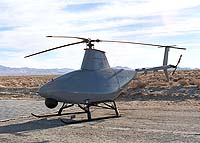
look no windows
look no windows |
The upgrade is compatible with the existing Fire Scout engine and transmission, and requires no major mechanical or structural changes to the airframe. Fire Scout currently uses a three-blade rotor configuration.
The Northrop Grumman/Schweizer team conducted ground, hover, taxi and flight evaluation of the four-bladed rotor hub mounted on a Schweizer Model 333 helicopter at Schweizer's Horseheads, N.Y., facility during the last week of March. To date, the team has conducted six flights with the aircraft reaching speeds up to 90 knots and altitudes up to 1,500 feet.
"These test flights mark the latest success in what has been flawless flight test program for the Fire Scout system," said T. Scott Winship, Northrop Grumman's Fire Scout program manager.
"Since we began our test program last May, the U.S. Navy/Northrop Grumman team has conducted 40 successful test flights." Preparations are being made to begin shipboard testing in April at the Webster Field UAV test facility at Naval Air Station Patuxent River, Md., he added.
According to Winship, the continuing flight test program has successfully demonstrated Fire Scout's ability to take off, fly, navigate and land autonomously while collecting and disseminating imagery from its onboard sensor payload. Flight tests to demonstrate laser targeting and designation are scheduled in May. A weapons delivery demonstration is planned for later this year.
Fully autonomous, Fire Scout can fly at altitudes up to 20,000 feet. Its advanced payload can provide intelligence, reconnaissance, surveillance and precise targeting information to tactical units either onboard ship or deployed in the field.
The air vehicle's communications suite provides a simultaneous voice/data communications relay capability that reaches much farther than current "line of sight" systems.
The Fire Scout system is produced by Northrop Grumman Integrated Systems' Unmanned Systems unit in San Diego, Calif.
Related Links
 UAV Roadmap Helps The 21st Century Warfighter
 Washington - Apr 03, 2003
| The content herein, unless otherwise known to be public domain, are Copyright 1995-2006 - SpaceDaily.AFP and UPI Wire Stories are copyright Agence France-Presse and United Press International. ESA PortalReports are copyright European Space Agency. All NASA sourced material is public domain. Additionalcopyrights may apply in whole or part to other bona fide parties. Advertising does not imply endorsement,agreement or approval of any opinions, statements or information provided by SpaceDaily on any Web page published or hosted by SpaceDaily. Privacy Statement |