|
 |
 |
 |
 |
 |
 |
 |
 |
 |

| . |  |
. |
First Detection Of CO In Uranus
Paris - Dec 18, 2003 A team from Paris Observatory, led by Th�r�se Encrenaz (LESIA), has just detected for the first time the molecule of carbon monoxide (CO) in the atmosphere of Uranus. The origin of this molecule is probably external to the planet, for example due to micrometeorites. In spite of their common status of "icy giants" in the outer solar system, the two giant planets Uranus and Neptune, with comparable sizes and densities, show significant differences. In particular, the CO and HCN molecules have been detected in large amounts in Neptune's stratosphere, from millimeter spectroscopy, while this technique was unsuccessful in the case of Uranus. The large abundance of CO in Neptune (about 1000 times more than in Jupiter and Saturn) suggests that this molecule comes mostly from the interior of the planet, which has major implications on its formation scenario. Indeed, this abundance is by several orders of magnitude larger than what could be provided by external flows. New measurements made in the infrared range have now allowed the detection of CO in the atmosphere of Uranus. This measurement has been made possible by the very high sensitivity of the infrared spectrometer ISAAC, mounted at the 8-m telescope UT1 (Antu) of the Very Large Telescope of ESO in Chile. The spectral signatures of CO appear in emission, and can be interpreted with a fluorescence mechanism by the solar radiation field. A complete modelling of the spectrum shows that the CO molecule is present in the lower stratosphere of Uranus (about 30 times less abundant than in Neptune), but is probably less abundant in the lower troposphere. This result, if confirmed, seems to imply an external origin for CO, which would come, like the water vapor detected in the giant planets' stratospheres, from an interplanetary flux of micrometeorites trapped in the planets' gravity field. The low abundance of CO in Uranus' troposphere could be evidence for differences in the internal structures of the two "icy giants". The atmosphere of Neptune appears much more turbulent than the one of Uranus, and the internal heat of Neptune, as measured by Voyager 2, is significantly larger. Neptune's internal energy would induce the atmospheric motion by convection, and would favor the uplift of internal CO, while this mechanism would be absent in the case of Uranus.
Figure 1: Chart Caption Related Links Observatoire de Paris SpaceDaily Search SpaceDaily Subscribe To SpaceDaily Express  Pushing Out The Kuiper Belt
 Boulder - Nov 26, 2003
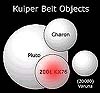
A new study by researchers at Southwest Research Institute (SwRI) and the Observatoire de la Cote d'Azur provides an explanation for one of the more mysterious aspects of the population of objects beyond Neptune. In doing so, it provides a unique glimpse into the proto-planetary disk from which the Solar System's planets formed. Results will be published in the November 27 issue of Nature. |
|
|

| The content herein, unless otherwise known to be public domain, are Copyright 1995-2006 - SpaceDaily.AFP and UPI Wire Stories are copyright Agence France-Presse and United Press International. ESA PortalReports are copyright European Space Agency. All NASA sourced material is public domain. Additionalcopyrights may apply in whole or part to other bona fide parties. Advertising does not imply endorsement,agreement or approval of any opinions, statements or information provided by SpaceDaily on any Web page published or hosted by SpaceDaily. Privacy Statement |