
 |
 |
 |
 |
 |
 |
 |
 |
 |
 |

| . |  |
. |
First Detection Of Magnetic Field In Distant Galaxy Produces A Surprise
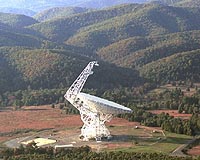
San Diego CA (SPX) Oct 02, 2008 Using a powerful radio telescope to peer into the early universe, a team of California astronomers has obtained the first direct measurement of a nascent galaxy's magnetic field as it appeared 6.5 billion years ago. Astronomers believe the magnetic fields within our own Milky Way and other nearby galaxies-which control the rate of star formation and the dynamics of interstellar gas--arose from a slow "dynamo effect." In this process, slowly rotating galaxies are thought to have generated magnetic fields that grew very gradually as they evolved over 5 billion to 10 billion years to their current levels. But in the October 2 issue of Nature, the astronomers report that the magnetic field they measured in this distant "protogalaxy" is at least 10 times greater than the average value in the Milky Way. "This was a complete surprise," said Arthur Wolfe, a professor of physics at UC San Diego's Center for Astrophysics and Space Sciences who headed the team. "The magnetic field we measured is at least an order of magnitude larger than the average value of the magnetic field detected in our own galaxy." The astronomers from the University of California campuses at Berkeley, San Diego and Santa Cruz used the world's largest fully steerable radio telescope for their measurements-the Robert C. Byrd Green Bank Telescope in Green Bank, West Virginia operated by the National Science Foundation's National Radio Astronomy Observatory. The young protogalaxy they probed, DLA-3C286, is located in a region of the northern sky that is directly overhead during the spring. Until recently, astronomers knew very little about magnetic fields outside our own galaxy, having directly measured the magnetic field in only one nearby galaxy. "And that field wasn't as strong as the field we saw," said Wolfe. But a team of Swiss and American astronomers reported in the July 17 issue of Nature that an indirect measurement of the magnetic fields of 20 distant galaxies, using the bright light from quasars, suggests that the magnetic fields of young galaxies were as strong when the universe was only a third of its current age as they are in the mature galaxies today. Wolfe said those indirect measurements and his team's latest direct measurement of a distant galaxy's magnetic field "do not necessarily cast doubt on the leading theory of magnetic field generation, the mean-field-dynamo model, which predicts that the magnetic field strengths should be much weaker in galaxies in the cosmological past." "Our results present a challenge to the dynamo model, but they do not rule it out," he added. "Rather the strong field that we detect is in gas with little if no star formation, and an interesting implication is that the presence of the magnetic fields is an important reason why star formation is very weak in these types of protogalaxies." Wolfe said his team has two other plausible explanations for what they observed. "We speculate that either we are seeing a field toward the central regions of a massive galaxy, since magnetic fields are known to be larger towards the centers of nearby galaxies. It is also possible that the field we detect has been amplified by a shock wave generated by the collision between two galaxies." "In either case," he added, "our detection indicates that magnetic fields may be important factors in the evolution of galaxies, and in particular may be responsible for the low star formation rates detected throughout the gaseous progenitors of young galaxies in the early universe." "The challenge now," said J. Xavier Prochaska, another member of the team who is a professor of astronomy at UC Santa Cruz, "is to perform observations like these on galaxies throughout the universe." Other researchers involved in the discovery were Regina Jorgenson, a UCSD graduate student in physics; Carl Heiles, a professor of astronomy at UC Berkeley; and Timothy Robishaw, a graduate student at Berkeley. The study was funded by a grant from the National Science Foundation. Community Email This Article Comment On This Article Share This Article With Planet Earth
Related Links University of California, San Diego Stellar Chemistry, The Universe And All Within It
 When It Comes To Galaxies, Diversity Is Everywhere
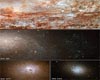 Baltimore MD (SPX) Oct 01, 2008
There's an old saying in astronomy: "Galaxies are like people. They're only normal until you get to know them." That view is supported by a group of astronomers after using NASA's Hubble Space Telescope to study a large number of galaxies in our cosmic backyard. |
|
|

| The content herein, unless otherwise known to be public domain, are Copyright 1995-2007 - SpaceDaily.AFP and UPI Wire Stories are copyright Agence France-Presse and United Press International. ESA Portal Reports are copyright European Space Agency. All NASA sourced material is public domain. Additional copyrights may apply in whole or part to other bona fide parties. Advertising does not imply endorsement,agreement or approval of any opinions, statements or information provided by SpaceDaily on any Web page published or hosted by SpaceDaily. Privacy Statement |
 del.icio.us
 Digg
Digg Reddit
 YahooMyWeb
 Google
 Facebook