|
 |
 |
 |
 |
 |
 |
 |
 |
 |

| . |  |
. |
First Direct Detection Of Light From Extrasolar Planets
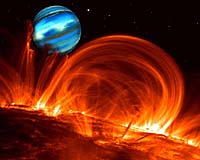
Cambridge MA (SPX) Mar 23, 2005 Two teams of astronomers announced at a press conference Wednesday that they have directly detected light from two known planets orbiting distant stars. This discovery opens a new frontier in the study of extrasolar planets. Researchers now can directly measure and compare such planetary characteristics as color, reflectivity, and temperature. A team led by David Charbonneau of the Harvard-Smithsonian Center for Astrophysics (CfA) will publish their detection of the planet TrES-1 in the June 20th issue of The Astrophysical Journal. A team led by Drake Deming of the Goddard Space Flight Center (GSFC) published their observations of the planet HD 209458b in today's online issue of Nature. "It's an awesome experience to realize we are seeing the glow of distant worlds," said Charbonneau. "When I first saw the data, I was ecstatic." Each of the two target planets periodically crosses in front of and behind its star. When in front, the planet partially eclipses the star and blocks a small portion of the star's light. Similarly, the system dims slightly when the planet disappears behind its star since the star blocks the planet's light. By observing this "secondary eclipse," astronomers can tease out the faint signal of the planet from the overwhelming light of the nearby star.
Planets Can't Hide The Heat Charbonneau and his colleagues used the Infrared Array Camera (IRAC), a Smithsonian-developed instrument aboard NASA's Spitzer Space Telescope, to observe TrES-1 in the infrared region of the spectrum. Deming and his associates used Spitzer's Multiband Imaging Photometer for Spitzer (MIPS) to observe HD 209458b. "Planets like TrES-1 are tiny and faint compared to their stars, but the one thing they can't hide is their heat," said Charbonneau. "We are like detectives. Previous clues told us the planet must be there, so we put on our 'infrared goggles' and suddenly, it popped into view." Infrared offers an advantage because the star outshines the planet by a factor of 10,000 in visible light, while in the infrared the star is only about 400 times brighter, making it easier to pick out a planet's feeble light. Astronomers compare the challenge to trying to spot a firefly buzzing next to a searchlight.
Planet TrES-1 IRAC team members Lori Allen and Tom Megeath (CfA) planned the TrES-1 observations, which required precise timing to catch the system just before and after the secondary eclipse, as well as precise pointing. Their experience and familiarity with the performance of the IRAC camera were crucial in obtaining the best data possible. Allen and Megeath also provided insights into IRAC instrument features encountered during data analysis. "Teasing out the signal from TrES-1 was both challenging and exciting," said Allen. "We were actually seeing light from another world hundreds of light-years away from us, circling around another sunlike star." Although two groups previously claimed to have directly photographed an extrasolar planet, neither one is confirmed and neither orbits a sun-like star. Using Spitzer data combined with previous measurements, Charbonneau and his colleagues confirmed that TrES-1, which orbits its star at a distance of 4 million miles, has a temperature of about 1,450 degrees Fahrenheit (1060 Kelvin). They also calculated that the planet has a reflectivity of only 31%, meaning it absorbs the majority of the star's light that falls on it. CfA researcher Guillermo Torres modeled the dynamics of the TrES-1 system to constrain the planet's orbit. He determined that the orbit has been made very nearly circular by the tidal effect of the nearby star, as expected.
Future Exoplanet Research Charbonneau is quick to point out that the achievement of directly detecting an extrasolar planet's light is only the beginning. "We've caught our first 'firefly.' Now we want to study a swarm of them." Astronomers expect the Trans-Atlantic Exoplanet Survey (TrES) network, which spotted TrES-1, to locate additional "hot Jupiters." That ground-based network is designed to spot planets orbiting bright stars, which can be more easily studied with Spitzer and other instruments. By comparing many "hot Jupiter" planets, researchers hope to determine what gases their atmospheres contain and how their composition was affected by when and how they formed. "We never imagined we would find planets as strange and varied as we have. Who knows what new worlds are waiting for us?" Said Charbonneau. The paper on the TrES-1 finding is authored by Charbonneau, Allen, Megeath, and Torres; Roi Alonso (IAC), Timothy Brown (NCAR), Ronald Gilliland (STScI), David Latham (CfA), Georgi Mandushev (Lowell Observatory), Francis O'Donovan (Caltech), and Alessandro Sozzetti (University of Pittsburgh/CfA). Related Links SpaceDaily Search SpaceDaily Subscribe To SpaceDaily Express  NASA's Spitzer Marks Beginning of New Age of Planetary Science
 Cambridge MA (SPX) Mar 23, 2005
NASA's Spitzer Space Telescope has for the first time captured the light from two known planets orbiting stars other than our Sun. The findings mark the beginning of a new age of planetary science, in which "extrasolar" planets can be directly measured and compared. |
|
|

| The content herein, unless otherwise known to be public domain, are Copyright 1995-2006 - SpaceDaily.AFP and UPI Wire Stories are copyright Agence France-Presse and United Press International. ESA PortalReports are copyright European Space Agency. All NASA sourced material is public domain. Additionalcopyrights may apply in whole or part to other bona fide parties. Advertising does not imply endorsement,agreement or approval of any opinions, statements or information provided by SpaceDaily on any Web page published or hosted by SpaceDaily. Privacy Statement |