|
 |
 |
 |
 |
 |
 |
 |
 |
 |

| . |  |
. |
First Double Star Spacecraft Declared Ready For Operations
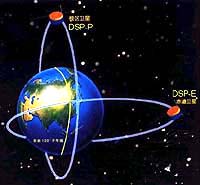
Paris - Mar 22, 2004 The China-ESA Double Star project is designed to use two spacecraft to study the Earth's magnetosphere, in concert with ESA's four spacecraft Cluster mission. The Double Star spacecraft are known as TC-1 and TC-2, or translating to English, as Explorer-1 and Explorer-2. Following its successful launch on 29 December 2003 and the commissioning of the spacecraft systems and the instruments, the first Double Star spacecraft (TC-1) was declared ready to start the nominal operation phase by the Commissioning Review Board. The Board, consisting of members from the Chinese National Space Agency (CNSA) and ESA, reviewed the performance of the spacecraft, instruments and ground segment of the Double Star mission during a meeting held at Villafranca (Spain) on 11 March 2004.
Spacecraft and Instrument Status
Ground Segment The three operation centres, the European Payload Operation System at RAL (UK), the Chinese Double Star Science Operation Centre and Double Star Operation and Management Centre are routinely operating both European and Chinese instruments. The European Data Disposition System at IWF (Austria) forwards raw data to the European users. Finally the Austrian, Chinese, French and United-Kingdom data centres have successfully exchanged and distributed preliminary science data.
Orbital Information The effect of ASPOC can clearly be observed in the electron spectrograms (bottom panel) in the diagram below. When ASPOC is activated, between 19:00-00:00 UT and 14:00-19:00 UT, the PEACE sensor measures the full electron spectrum from the surrounding medium, while when ASPOC is off, 01:00-13:00, photoelectrons coming from the spacecraft dominate at low energy (below 10 eV, large red band at the bottom of the plot).
Science Results Due to its unique orbit, with an apogee around 13.5 Earth radii of geocentric distance, TC-1 at times skims along the bow shock. TC-1 therefore has a better chance to observe the bowshock for relatively long intervals than other spacecraft that have visited this region. On Figure 3, before 07:05 UT the spacecraft was in the magnetosheath, then between 07:05 and 07:13, the spacecraft was very close to the bow shock, and later between 07:13 and 07:17 it was in the solar wind. During this event, the ions show a clear energy increase with time, observed around 07:12 UT. These ions from the solar wind are thought to have been reflected at the bow shock so that they now partly move back toward the Sun and are accelerated by the shock in the process. This very clear energy dispersion should help us to find their origin and understand better the role of the bow shock in accelerating particles to high energies. The strong burst of low frequency waves that are simultaneously observed by the STAFF experiment might play a role in this process. Such new knowledge will have wide significance since similar processes are thought to energise particles in many astrophysical environments. Related Links Doublestar SpaceDaily Search SpaceDaily Subscribe To SpaceDaily Express  SOHO Snaps Spectacular Sun Shot
 Paris - Mar 17, 2004
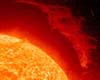
On Friday, 12 March 2004, the Sun ejected a spectacular 'eruptive prominence' into the heliosphere. SOHO, the ESA/NASA solar watchdog observatory, faithfully recorded the event. |
|
|

| The content herein, unless otherwise known to be public domain, are Copyright 1995-2006 - SpaceDaily.AFP and UPI Wire Stories are copyright Agence France-Presse and United Press International. ESA PortalReports are copyright European Space Agency. All NASA sourced material is public domain. Additionalcopyrights may apply in whole or part to other bona fide parties. Advertising does not imply endorsement,agreement or approval of any opinions, statements or information provided by SpaceDaily on any Web page published or hosted by SpaceDaily. Privacy Statement |